Articles | Volume 17, issue 1
https://doi.org/10.5194/hgss-17-37-2026
© Author(s) 2026. This work is distributed under
the Creative Commons Attribution 4.0 License.
the Creative Commons Attribution 4.0 License.
https://doi.org/10.5194/hgss-17-37-2026
© Author(s) 2026. This work is distributed under
the Creative Commons Attribution 4.0 License.
the Creative Commons Attribution 4.0 License.
Article
| 
02 Apr 2026
Article |
| 02 Apr 2026
| 02 Apr 2026
A 300-year history of understanding and classifying clouds, from a German language perspective
Peter Winkler
CORRESPONDING AUTHOR
independent researcher: Hechenbergstr. 9, 82362 Weilheim, Germany
Related authors
Peter Winkler
Hist. Geo Space. Sci., 14, 93–120, https://doi.org/10.5194/hgss-14-93-2023, https://doi.org/10.5194/hgss-14-93-2023, 2023
Short summary
Short summary
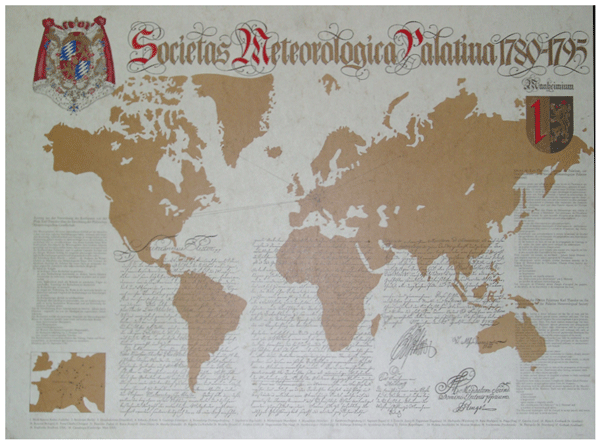
The foundation of the Societas Meteorologica Palatina was the most important step toward a physical consideration of meteorology. The organization was exemplary for later observational networks. The data were printed in 12 volumes of ephemerides, being for a long time the most important and reliable database for scientific research. This data pool is not only of historical interest, but it is also used in modern research in many fields.
Peter Winkler
Hist. Geo Space. Sci., 14, 93–120, https://doi.org/10.5194/hgss-14-93-2023, https://doi.org/10.5194/hgss-14-93-2023, 2023
Short summary
Short summary
The foundation of the Societas Meteorologica Palatina was the most important step toward a physical consideration of meteorology. The organization was exemplary for later observational networks. The data were printed in 12 volumes of ephemerides, being for a long time the most important and reliable database for scientific research. This data pool is not only of historical interest, but it is also used in modern research in many fields.
Cited articles
Abercromby, R.: Principles of forecasting by means of weather charts, London, 1885.
Abercromby, R.: Suggestions for an international nomenclature of clouds, Q. J. Roy. Meteor. Soc., XIII, 154–166, 1887a.
Abercromby, R.: On the identity of cloud forms all over the world, Q. J. Roy. Meteor. Soc., 13, 140–146, 1887b.
Anonymus: Wolken im Luftmeer, Lichtbilder aufgenommen von deutschen Fliegern während des Krieges, s. l., 1917.
Archenhold, G. H.: A solar halo phenomenon, Nature, 3898, 433, 1944.
Assmann, R.: Mikroskopische Beobachtungen der Wolkenelemente auf dem Brocken, Meteorol. Z., 2, 41–47, 1885.
Assmann, R.: Referat über Kießling, J. Untersuchungen über Dämmerungserscheinungen zur Erklärung der nach dem Krakatau-Ausbruch beobachteten atmosphärisch-optischen Störung, Das Wetter, 7, 274–276, 1887.
Assmann, R.: Ergebnisse des k. Aeronautischen Observatoriums Lindenberg im Jahre 1905, Berlin, I-XXII, 1906.
Assmann, R., Berson, A., von Bezold, W., Börnstein, R., and Süring, R. (Eds.): Wissenschaftliche Luftfahrten, Braunschweig, 1900.
Bénard, H.: Les tourbillons cellulaires dans une nappe liquide, Revue Générale des Sciences, 11, 1261–1271, 1309–1328, 1900.
Berns, J. J.: Wolkenspektakel, in: Theatrale Himmelsprodigien auf frühneuzeitlichen Flugblättern, edited by: Berns, J. J. and Rahn, Th, Projektierte Himmel, Wiesbaden, 181–208, 2019.
Binder, H. and Madonna, E.: Warm conveyor belts, Promet, 103, 59–66, 2020.
Bjerknes, J.: On the structure of moving cyclones, Mon. Weather Rev., 47, 95–99, 1919.
Bluestein, H. B.: The architecture of clouds, Oxford University Press, Oxford, 2024.
Börngen, M. and Foken, T.: 150 Years: The Leipzig Meteorological Conference, 1872, a milestone in international meteorological cooperation, Meteorol. Z., 31, 415–427, 2022.
Börnstein, R.: Leitfaden der Wetterkunde, Vieweg, Braunschweig, 1901.
Brooks, C. F.: Clouds in aerology and forecasting, B. Am. Meteor. Soc., 22, 335–345, https://doi.org/10.1175/1520-0477-22.9.335, 1941.
Cannegieter, H. G.: The history of the International Meteorological Organization 1872–195, Annalen der Meteorologie, N. F. Nr. 1, Selbstverlag des Deutschen Wetterdienstes, Offenbach, 1963.
Christensen, H. M. and Driver, O. G. A.: The fractal nature of clouds in global storm-resolving models, Geophys. Res. Lett., 48, https://doi.org/10.1029/2021GL095746, 2021.
Christie, D. R.: The morning glory of the Gulf of Carpentaria: a paradigm for non-linear waves in the lower atmosphere, Aust. Meteorol. Mag., 41, 21–60, 1992.
Clarke, G. A.: Clouds, A descriptive illustrated guide book to the observation and classification of clouds, Constable, London, 1920.
Clayden, A. W.: Cloud studies, Murray, London, 1905.
Clayton, H. H.: Discussion of the cloud observation, Annals of the Astronomical Observatory of Havard College, XXX, Part IV, 1896.
Dalin, P., Pertsev, N., and Romejko, V.: Notes on historical aspects on the earliest known observations of noctilucent clouds, Hist. Geo Space Sci., 3, 87–97, 2012.
Dannemann, F.: Otto von Guericke's neue Magdeburgische Versuche über den leeren Raum (1672), Oswalds Klassiker der exakten Wissenschaften, 59, Leipzig, 1889.
de Quervain, A.: Zur Kenntnis der Wolkenformen, Meteorol. Z., 39, 157–158, 1904.
de Quervain, A.: Beiträge. zur Wolkenkunde, Meteorol. Z., 25, 433–453, 1908.
de Lamarck, J.-B.: Sur la forme des nuages, Annuaire Météorologique pour l'An 1801–1802, 149–164, 1802.
de Touchimbert, M.: Les courants Aériens, Compte Rendue, 500–505, 1879.
Deluc, J. A.: Idées sur la météorologie, Spilsbury, London, 1786.
Dorno, C.: Zur Frage der Polarbanden, Die Himmelswelt 35, 11–13, 1925.
Dove, H. W.: Meteorologische Untersuchungen, Sander, Berlin, 1837.
Dubois, P.: Das Observatorium Lindenberg in seinen ersten 50 Jahren 1905–1955, Geschichte der Meteorologie in Deutschland, Offenbach, Bd. 1, 1993.
Durr, L. and Wehrlé, P.: Atlas des Nuages. Paris, 1926.
Eaton, A. A.: Cloud formation, Science, 21, 346–347, 1893.
Erk, F.: Über die Einwirkung von Flußläufen auf eine darüber befindliche Wolkendecke, Meteorol. Z., 33, 216–225, 1898.
Espy, J. P.: The philosophy of storms, Boston, https://doi.org/10.5479/sil.1109113.39088016470767, 1841.
Ettenreich, R.: Wolkenbildung über einer Feuersbrunst und an Flugzeugabgasen, Meteorol. Z., 36, 355–356, 1919.
Ferguson, S. P. and Brooks, C. F.: Formation of a cumulus cloud over a fire, Science, 10, 86, 1899.
Ferri, P. D.: The formation and forecasting of condensation trails behind modern aircraft, Meteorol. Appl., 3, 301–306, 1996.
Fontseré, E.: Atlas Elemental de Núvols, Gili, Barcelona, 1925.
Forster, T.: Researches about atmospheric phaenomena, London, 1813.
Föyn, N. J.: Wolken-Beobachtungen, Grøndahl, Christiania, 1900.
Fraunhofer, J.: Theorie des Mondhofs und der Haloerscheinungen als Beugungs- und Brechungsphänomene, Akademie der Wissenschaften München, 1825.
Gilbert, L. W.: Über die Modifikationen der Wolken von Lukas Howard, Ann. Phys., 21, 137–159, 1805.
Grossmann, L. A.: Zur Beobachtung der Wolken, after Clement Ley, Cloudland, London (1894), Annalen der Hydrographie und Maritimen Meteorologie, 23, 493–505, 1894.
Grünpeck, J.: Ein newe außlegung Der seltzamen wundertzaichen vnd wunderpürden, so ein zeyther im reich, als vorpoten des Almechtige[n] gottes, auffmonende auffrüstig zesein wider die feindt christi vnd des heyligen reichs, erschinen sein: an all Kurfürsten vnnd Fürsten so auff dem reichs tag zu Costnitz versamlt sein gewesen, Nürnberg, 1515.
Guericke, O. V.: Experimenta Nova (ut vocantur) Magdeburgica de Vacuo Spatio, Janssonium & Waesberge, Amsterdam, 1672.
Halley, E.: An account of the circulation of the sea, and of the cause of the springs, Phil. Transactions, III, 468–473, 1690.
Hamanaka, H.: Erkenntnis und Bild – Wissenschaftsgeschichte der Lichtenbergischen Figuren um 1800, Göttingen, https://doi.org/10.1002/bewi.201601781, 2015.
Heinecke, B., Knapp, W., Rubini, P., and Streitenberger, P.: Leibniz und Guericke im Diskurs. Die Exzerpte aus den Experimenta Nova und der Briefwechsel, De Gruyter, Berlin, Boston, 2019.
Hellmann, G.: Das Magnetisch-Meteorologische Observatorium bei Potsdam, Berlin, 1912.
Helmholtz, H.: Über atmosphärische Bewegungen, Sitzungsberichte der K. Preuss. Akad. Wiss., 647–663, 1888.
Hildebrandsson, H. H.: Atlas des mouvements supérieurs de l'atmosphère, Stockholm, 1877.
Hildebrandsson, H. H.: Wolkenformen und Wolkenbilder, Meteorol. Z., 24, 441–447, 1889.
Hildebrandsson, H. H.: Internationaler Wolken-Atlas, ed. on behalf of the International Cloud Committee, Gauthier, Paris, 1896.
Hildebrandsson, H. H., Köppen, W., and Neumayer, G.: Atlas des Nuages – Wolkenatlas, Seitz, Hamburg, 1890.
Hooke, R.: A method for making a history of the weather, in: The history of the Royal Society of London, edited by: Sprat, T., for the improving of natural knowledge, Martyn, London, 173–179, 1667.
Howard, L.: On the Modifications of Clouds, Philos. Mag., 26, 344–357, 1803.
Hube, J. M.: Über Ausdünstungen und ihre Wirkungen in der Atmosphäre, Göschen, Leipzig, 1790.
International Commission for the Study of Clouds (Ed.): International Atlas of Clouds and of States of the Sky. Office national météorologique, 2nd edn., 1939.
Jelinek, K.: Anleitung zur Anstellung meteorologischer Beobachtungen und Sammlung von Hilfstafeln, Wien, 1876.
Jesse, O.: Auffallende Abenderscheinung am Himmel, Meteorol. Z., 2, 311–312, 1885.
Jesse, O.: Eine auffallende Abenderscheinung am Himmel im Juni und Juli 1885, Meteorol. Z., 3, 8–18; 64–71, 1886.
Jesse, O.: Die Beobachtung der leuchtenden Nachtwolken, Meteorol. Z., 4, 179–181, 1887.
Kämtz, F. L.: Lehrbuch der Meteorologie, Gebauer, Halle, 3 Vols., 1831–1836.
Kober, J.: Ueber die angeblichen Dunstbläschen in der Atmosphäre, Ann. Phys. Chem., 141, 395–427, 1871.
Koppe, C.: Photogrammetrie und internationale Wolkenmessung, Vieweg, Braunschweig, 1896.
Köppen, W.: Einiges über die Wolkenformen, Meteorol. Z., 22, 203–214; 252–261, 1887.
Köppen, W.: Zwei merkwürdige Nachtgewitter im Sommer 1890, Annalen der Hydrographie und maritimen Meteorologie 19, 84–90, 1891.
Köppen, W.: Volkswetterkunde by E. Mylius, Mitteilungen der Dutschen Seefischerei, 352–353, XXV, 1909.
Koterba, A. and Huu, A. N.: Accuracy of cirrus detection by surface-based human observers, J. Climate, 25, 3227–3241, https://doi.org/10.1175/JCLI-D-21-0430.1, 2020.
Kratzenstein, C. G.: Théorie d'élevation des vapeurs et des exhalations, Bordeaux, 1743.
Kratzenstein, C. G.: Abhandlung von dem Aufsteigen der Dünste und Dämpfe welche von der Academie zu Bourdeaux den Preiss erhalten, Hemmerde, Halle, 1744.
Kuhn, C.: Über di Constitution der Wolken, Z. österr. Ges. für Meteorologie, 1, 346–348, 1866.
Lampadius, W. A.: Systematischer Grundriß der Atmosphärologie, Gerlach, Freiberg, 1806.
Leibniz, G. F.: De elevatione vaporum, Miscellanea Berolinensia ad incrementum scientiarum 1, 123–128, 1710.
Ley, C. W.: Clouds and weather signs, in: Modern Meteorology, edited by: Meteorological Society, London, 102–136, 1879.
Ley, C. W.: Über die Struktur des ”Cirro-filum”, oder der fadenförmigen Eiswolke, Meteorol. Z., 1, 261–271, 1884.
Ley, C. W.: Cloudland, A study on the structure and characters of clouds, Stanford, London, 1894.
Ludewig, P.: Die Messung vertikaler Luftströmungen, Resultate von wissenschaftlichen Freiballonfahrten, Hirzel, Leipzig, 1911.
MacCracken, M. C. and Volkert, H.: IAMAS: a century of international cooperation in atmospheric sciences, Hist. Geo Space. Sci., 10, 119–136, https://doi.org/10.5194/hgss-10-119-2019, 2019.
Mason, J.: The physics of clouds, Oxford, 1957.
McDonald, J. E.: James Espy and the beginnings of cloud thermodynamics, B. Am. Meteorol. Soc., 44, 634–643, https://doi.org/10.1175/1520-0477-44.10.634, 1963.
Meister, A. F. L.: Beobachtungen merkwürdiger Gestalten der Wolken, Göttingisches Magazin der Wissenschaften, 1, 38–68, 1780.
Mohn, H.: Irisierende Wolken, Meteorol. Z., 10, 81–97, 1893.
Mohorovičić, A.: Wolkenmessung, Meteorol. Z., 27, 326–327, 1888.
Mohorovičić, A.: Interessante Wolkenbildung über der Bucht von Buccari, Meteorol. Z., 24, 56–57, 1889.
Murphy, J. J.: Clouds, Nature 10, 20, 1870.
Mylius, E.: Aquarellmalerei im Dienste meteorologischer Beobachtungen, Das Wetter, 23, 255–261, 1906.
Mylius, E.: Wolkenbilder: nach Aquarellen von E. Mylius, edited by: Frank, H., Graph, Kunstanstalt, Böhm, Leipa, 1944.
Neuber, A. W.: Observationes meteorologicae a Cal. Juniis 1824 ad Cal. Junias 1825, Apenroae in Ducatu Slesvicensi factae Observationes meteorologicae a Cal. Juniis 1824 ad Cal. Junias 1825, Hafnia, 1829.
Neuhoff, O.: Adiabatische Zustandsänderungen feuchter Luft, Abhandl. des k. Preuss. Met. Inst., 1.6, Berlin, 1900.
Osthoff, H.: Der Mammato-Cumulus, Meteorol. Z., 23, 401–408, 1906.
Parthey, G.: Nachschrift von Alexander von Humboldt: Vorlesungen über physikalische Geographie. Novmbr. 1827 bis April 1828. in der Berliner Universität, Deutsches Textarchiv, Marbach, 1828.
Poey, A.: Sur deux nouveaux types de nuages observés a la Havane et Dénommés Pallium (Pallio-cirrus et Pallio-cumulus) et Fracto-cumulus, Annuaire de la Société Météorologique de France XI, 53–56, 1863.
Poey, A.: Neue Classification der Wolken, Z. d. öster. Ges. Meteorologie, IX, 177–183, 1874.
Poulter, R. M.: Cloud forecast with tephigram (1938), Q. J. Roy. Meteorol. Soc., 64, 277–292, 1938.
Prestel, A. M. F.: Die Polarbanden als Aeroklinoskop, Z. öster. Ges. für Meteorologie, 9, 69–372, 1874.
Quante, M.: Turbulenz in Cirruswolken mittlerer Breiten, Phd-thesis, Hamburg, 2006.
Rayleigh, O. M.: On convection currents in a horizontal layer of fluid, when the higher temperature is on the underside, The London, Edinburgh, and Dublin Philosophical Magazine and Journal of Science, 32, 529–546, 1916.
Ricco, A. and Saija, R.: Saggio di meteorologia dell' Etna, Annali dell' Ufficio meteorologico e geodinamico Italiano, XVII, 39–108, 1895.
Riggenbach, A.: On a method of photographing cirrus clouds, Q. J. Roy. Meteor. Soc. XV, 16, 1889.
Schereschewsky, P. and Wehrlé, P.: Les systemes nuageux, Paris, 2 Vols., 1923.
Schleich, A.: Bemerkungen zum Wolkenquadrant, Meteorol. Z., 67, 278–279, 1932.
Schmauß, A.: Explosionswellen auf Wolkenoberflächen, Meteorol. Z., 57, 80, 1940.
Schmidt, E.: Die Entstehung von Eisnebel aus den Auspuffgasen von Flugmotoren, Vortrag 15.3.1940, Schriften der Dt. Akademie der Luftfahrtforschung, 44, 1–25, 1941.
Schott, C.: Technica curiosa sive mirabilia artis, Endter, Nürnberg and Hertz, Würzburg, 1664.
Schultz, D. M., Kanak, K. M., Straka, J. M.,, Trapp, R. J., Gordon, B. A., Zrnić, D., Zrnic, D. S., Bryan, G. H., Durant, A. J., Garrett, T. J., Klien, P. M., and Lilly, D. K.: The mysteries of mammatus clouds. Observations and Formation Mechanisms, J. Atmos. Sci., 63, 2409–2435, 2006.
Shaw, N.: Manual of Meteorology. Vol. IV, University Press, Cambridge, 1919.
Shaw, N.: Manual of Meteorology, Vol. 1, London, 1926.
Schopenhauer, A.: Parerga und Paraphilomena, Berlin, 1862.
Singer, K.: Wolkentafeln: Les formes des nuages. 12 Bilder in Kupferlichtdruck, unter Mitarbeit Hildebrandsson, Riggenbach, Garnier, Ackermann, München, 1892.
Spänkuch, D., Hellmuth, O., and Görsdorf, U.: What is a cloud? Towards a more precise definition, B. Am. Meteorol. Soc., 103, E1894–E1929, https://doi.org/10.1175/BAMS-D-21-0032.1, 2022.
Sprung, A.: Vorschlag zur Vereinfachung der korrespondierenden Wolkenaufnahmen, Meteorol. Z., 30, 217–220, 1895.
Störmer, C.: Mother-of-Pearl-Clouds over Skandinavia, Nature, 129, 941, 1932.
Störmer, C.: Height of Mother of Pearl Clouds observed in Southern Norway during 1926–34, Nature, 145, 221–222, 1940.
Strachey, R. and Whipple, G. M.: Cloud photography conducted under the Meteorological Council at the Kew Observatory, Proc. Roy. Soc. London, 49, 467–480, 1891.
Stüve, G.: Die Trennungsflächen der Atmosphäre, Ergebnisse der Aerologischen Tagung vom 3. bis 6. Juli 1921 im Preussischen Aeronautischen Observatorium Lindenberg, 42–46, 1922.
Süring, R.: Wissenschaftliche Ballonfahrten, Sammlung populärer Schriften, 36, Berlin, 1895.
Süring, R.: Die Wolkenbildungen, edited by: Assmann, R., Baschin, O., Berson, A., Börnstein, R., Gross, H., Kremser, V., Stade, H., and Süring, R., 1900 – Wissenschaftliche Luftfahrten, 179–195, 1900.
Süring, R.: Schichtbildungen in der Atmosphäre, Illustrierte aeronautische Mitteilungen, 5, 97–104, 1901.
Süring, R.: Schichtbildungen in der Atmosphäre, in: Bernhard Lepsius und Richard Wachsmuth (Hg.): Denkschrift der Ersten Internationalen Luftschiffahrts-Ausstellung (ILA) zu Frankfurt a/M. 1909, Springer, Berlin, Heidelberg, 234–245, 1910.
Süring, R.: Photogrammetrische Wolkenforschung in Potsdam in den Jahren 1900 bis 1920, Veröffentlichungen des Preußischen Meteorologischen Instituts, 7.3, 18–23, 1922.
Tissandier, G.: L'Océan aérien – Ètudes météorologiques, Paris, 1886.
Tromholdt, S.: Nordlichter und Polarbanden in den Monaten April und Mai beobachtet zu Svanholsminde in Jütland, Wochenschrift für Astronomie, Meteorologie und Geographie, 15, 262–264, 1873.
Turgan, J. F.: Les Ballons, Plom frères, Paris, 1851.
US Department of Agriculture: Cloud forms according to the International System of Classification, 1924.
US Hydrographic Office: Illustrative cloud forms for the guidance of observers in the classification of clouds, Washington, 1897.
Vettin, F. U.: Die Luftströmung über Berlin, Österr. Z. Meteorol., 17, 267–275; 351–358, 1882.
Vincent, J.: Les faux cirrus de alto cumulus, Observatoire Royale de Belgique Service Météorologique, 1901.
Vincent, J.: Atlas des nuages.Annales Météorologiques de l'Observatoire royal de Belgique, 1907.
von Bezold, W.: Zur Thermodynamik der Atmosphäre, Sitzungsberichte der k. preuss. Akad. Wiss. Berlin XVII, 485–522, 1888.
von Bezold, W.: Die Meteorologie als Physik der Atmosphäre, Sammlung populärer Schriften, 16, Berlin, 1892.
von Bezold, W.: Über Wolkenbildung, Sammlung populärer Schriften, 24, Berlin, 1894.
Waller, A. V.: Microscopic observations on the so-called vesicular vapours of water, as existing in the vapours of steam, and in clouds, Philos. T. Roy. Soc. London, 137, 23–30, 1847.
Wang, P.-H., McCormick, M. P., Poole, L. R., Chu, W. P., Yue, G. K., Kent, G. S., and Skeens, K. M.: Tropical high cloud characteristics derived from Sage II extinction measurements, Atmos. Res., 34, 53–83, https://doi.org/10.1016/0169-8095(94)90081-7, 1994.
Ward, R. D.: Clouds over a fire, Science, 5, 60–61, 1897.
Wegener, A.: Thermodynamik der Atmosphäre, Barth, Leipzig, 1911.
Wegener, A.: Frostübersättigung und Cirrus, Meteorol. Z., 8–12, 1920.
Wegener, K. and Schneider, K.: Flug und Wind, Die Arbeiten des Preußischen Aeronautischen Observatoriums Lindenberg XV, 251–270, 1926.
Weickmann, L.: Wolkenbildung, Die Naturwissenschaften, 7, 625–628, 1919.
Weilbach, P.: Nordeuropas skyformer, Met. Inst., Kopenhagen, 1881.
Wells, E. D.: Clouds formed by airplanes, Sci. Am., 120, 601, 1919.
WMO (World Meteorological Organisation): International Cloud Atlas, Geneva, The newest edition of 2018, https://cloudatlas.wmo.int/en/definitions-of-clouds.html (last access: 1 November 2025), 1956.
Wolf, H.: Wolken, Spiegel, Uhren, Fotogeschichte, 13, 3–18, 1993.
Wolff, Ch.: Allerhand Nützliche Versuche, Dadurch Zu genauer Erkäntnis Der Natur und Kunst Der Weg gebähnet wird, Halle, 1722.
Zöllner, F.: Über das Nordlicht in seiner Beziehung zur Wolkenbildung, Berichte über die Verhandlungen der k. sächs. Gesellschaft der Wissenschaften zu Leipzig, 23, 329–332, 1871.
Short summary
Before the Enlightenment, clouds were described phenomenologically. The vacuum pump’s invention enabled the formation of mist droplets by experiment, prompting questions about why clouds float. Around 1800, early proposals for cloud classification emerged. However, it wasn’t until manned balloon ascents provided detailed atmospheric data that the physical basis of cloud formation became clear, even though accurately depicting clouds in atlases remained challenging for some decades.
Before the Enlightenment, clouds were described phenomenologically. The vacuum pump’s invention...


