Articles | Volume 13, issue 2
https://doi.org/10.5194/hgss-13-93-2022
© Author(s) 2022. This work is distributed under
the Creative Commons Attribution 4.0 License.
the Creative Commons Attribution 4.0 License.
https://doi.org/10.5194/hgss-13-93-2022
© Author(s) 2022. This work is distributed under
the Creative Commons Attribution 4.0 License.
the Creative Commons Attribution 4.0 License.
Review article
| 
12 Jul 2022
Review article |
| 12 Jul 2022
| 12 Jul 2022
Global tephra studies: role and importance of the international tephra research group “Commission on Tephrochronology” in its first 60 years

School of Science/Te Aka Mātuatua, University of Waikato, Kirikiriroa/Hamilton, Aotearoa/New Zealand
Peter M. Abbott
Climate and Environmental Physics, Physics Institute, University of Bern, Bern, Switzerland
Oeschger Centre for Climate Change Research, University of Bern, Bern, Switzerland
Takehiko Suzuki
Department of Geography, Tokyo Metropolitan University, Tokyo, Japan
Britta J. L. Jensen
Department of Earth and Atmospheric Sciences, University of Alberta, Edmonton, Alberta, Canada
Related authors
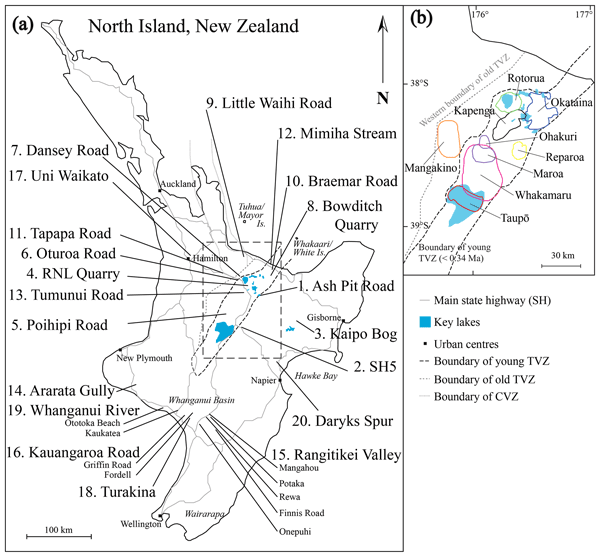
Jenni L. Hopkins, Janine E. Bidmead, David J. Lowe, Richard J. Wysoczanski, Bradley J. Pillans, Luisa Ashworth, Andrew B. H. Rees, and Fiona Tuckett
Geochronology, 3, 465–504, https://doi.org/10.5194/gchron-3-465-2021, https://doi.org/10.5194/gchron-3-465-2021, 2021
Short summary
Short summary
Here we present the foundation dataset for TephraNZ, a formal, comprehensive, open-access reference dataset of glass-shard compositions for New Zealand tephras. We geochemically characterise 45 eruptive episodes ranging from Kaharoa (ca. 636 cal yr BP) to the Hikuroa Pumice member (ca. 2.0 Ma) from six or more caldera sources, most from the central Taupō Volcanic Zone.
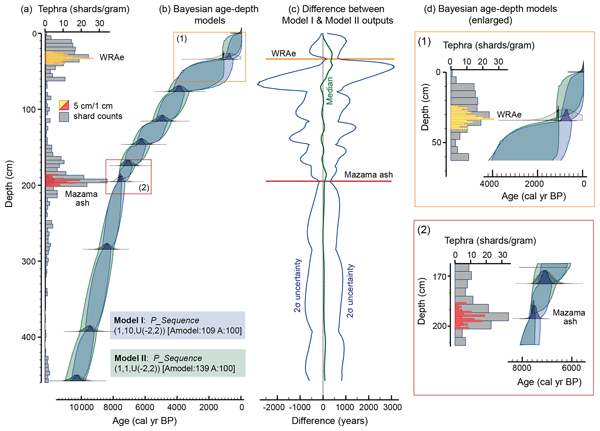
Alistair J. Monteath, Matthew S. M. Bolton, Jordan Harvey, Marit-Solveig Seidenkrantz, Christof Pearce, and Britta Jensen
Geochronology, 5, 229–240, https://doi.org/10.5194/gchron-5-229-2023, https://doi.org/10.5194/gchron-5-229-2023, 2023
Short summary
Short summary
Accurately dating ocean cores is challenging because the radiocarbon age of water masses varies substantially. We identify ash fragments from eruptions more than 4000 km from their source and use these time markers to develop a new age–depth model for an ocean core in Placentia Bay, North Atlantic. Our results show that the radiocarbon age of waters masses in the bay varied considerably during the last 10 000 years and highlight the potential of using ultra-distal ash deposits in this region.
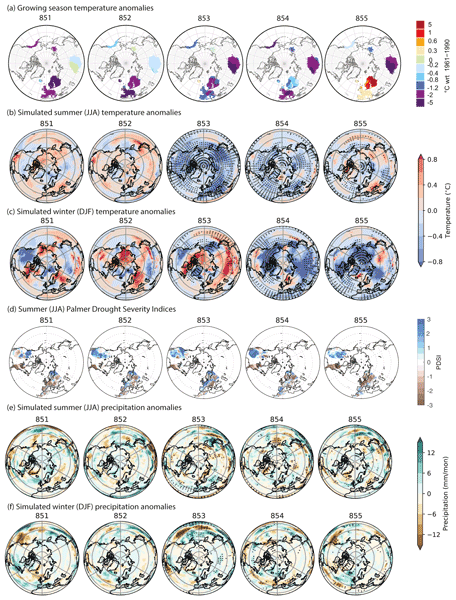
Helen Mackay, Gill Plunkett, Britta J. L. Jensen, Thomas J. Aubry, Christophe Corona, Woon Mi Kim, Matthew Toohey, Michael Sigl, Markus Stoffel, Kevin J. Anchukaitis, Christoph Raible, Matthew S. M. Bolton, Joseph G. Manning, Timothy P. Newfield, Nicola Di Cosmo, Francis Ludlow, Conor Kostick, Zhen Yang, Lisa Coyle McClung, Matthew Amesbury, Alistair Monteath, Paul D. M. Hughes, Pete G. Langdon, Dan Charman, Robert Booth, Kimberley L. Davies, Antony Blundell, and Graeme T. Swindles
Clim. Past, 18, 1475–1508, https://doi.org/10.5194/cp-18-1475-2022, https://doi.org/10.5194/cp-18-1475-2022, 2022
Short summary
Short summary
We assess the climatic and societal impact of the 852/3 CE Alaska Mount Churchill eruption using environmental reconstructions, historical records and climate simulations. The eruption is associated with significant Northern Hemisphere summer cooling, despite having only a moderate sulfate-based climate forcing potential; however, evidence of a widespread societal response is lacking. We discuss the difficulties of confirming volcanic impacts of a single eruption even when it is precisely dated.

Lauren J. Davies, Britta J. L. Jensen, and Darrell S. Kaufman
Geochronology, 4, 121–141, https://doi.org/10.5194/gchron-4-121-2022, https://doi.org/10.5194/gchron-4-121-2022, 2022
Short summary
Short summary
Subarctic and Arctic lake sediments provide key data to understand natural climate variability and future climate change. However, they can be difficult to date accurately and of limited use without a robust chronology. We use volcanic ash deposits from the last ~4000 BP to identify anomalously old radiocarbon ages at Cascade Lake, Alaska. A provisional ~15 000-year Bayesian age model is produced for the lake, and a new location for ash from five Late Holocene eruptions is reported.
Jenni L. Hopkins, Janine E. Bidmead, David J. Lowe, Richard J. Wysoczanski, Bradley J. Pillans, Luisa Ashworth, Andrew B. H. Rees, and Fiona Tuckett
Geochronology, 3, 465–504, https://doi.org/10.5194/gchron-3-465-2021, https://doi.org/10.5194/gchron-3-465-2021, 2021
Short summary
Short summary
Here we present the foundation dataset for TephraNZ, a formal, comprehensive, open-access reference dataset of glass-shard compositions for New Zealand tephras. We geochemically characterise 45 eruptive episodes ranging from Kaharoa (ca. 636 cal yr BP) to the Hikuroa Pumice member (ca. 2.0 Ma) from six or more caldera sources, most from the central Taupō Volcanic Zone.
Cited articles
Abbott, P. M. and Davies, S. M.: Volcanism and the Greenland ice-cores: the tephra record, Earth-Sci. Rev., 115, 173–191, 2012.
Abbott, P. M., Griggs, A. J., Bourne, A. J., and Davies, S. M.: Tracing marine cryptotephras in the North Atlantic during the last glacial period: protocols for identification, characterisation and evaluating depositional controls, Mar. Geol., 401, 81–97, 2018a.
Abbott, P. M., Griggs, A. J., Bourne, A., Chapman, M. R., and Davies, S.: Tracing marine cryptotephras in the North Atlantic during the last glacial period: improving the North Atlantic marine tephra framework, Quaternary Sci. Rev., 189, 169–186, 2018b.
Abbott, P. M., Jensen, B. J. L., Lowe, D. J., Suzuki, T., and Veres, D.: Crossing new frontiers: extending tephrochronology as a global geoscientific research tool, J. Quaternary Sci., 35, 1–8, 2020a.
Abbott, P. M., Jensen, B. J. L., Lowe, D. J., Suzuki, T., and Veres, D.: Tephrochronology as a global geoscientific research tool, J. Quaternary Sci., 35, 1–379, 2020b.
Abbott, P. M., Bonadonna, C., Bursik, M., Cashman, K., Davies, S., Jensen, B., Kuehn, S., Kurbatov, A., Lane, C., Plunkett, G., Smith, V., Thomlinson, E., Thordarsson, T., Walker, J. D., and Wallace, K.: Best practice templates for tephra collection, analysis, and correlation (Version 3.0.0), Zenodo [data set], https://doi.org/10.5281/zenodo.3866266, 2021.
Albert, P. G., Smith, V. C., Suzuki, T., McLean, D., Tomlinson, E. L., Miyabuchi, Y., Kitaba, I., Mark, D. F., Moriwaki, H., SG06 Project Members, and Nakagawa, T.: Geochemical characterisation of the Late Quaternary widespread Japanese tephrostratigraphic markers and correlations to the Lake Suigetsu sedimentary archive (SG06 core), Quat. Geochronol., 52, 103–131, 2019.
Alloway, B. V., Froese, D. G., and Westgate, J. A.: Proceedings of the International Field Conference and Workshop of Tephrochronology and Volcanism: Dawson City, Yukon Territory, Canada (31 July–8 August 2005). Institute of Geological and Nuclear Sciences Science Report 2005/22, 69 pp., 2005.
Alloway, B. V., Lowe, D. J., Barrell, D. J. A., Newnham, R. M., Almond, P. C., Augustinus, P. C., Bertler, N. A., Carter, L., Litchfield, N. J., McGlone, M. S., Shulmeister, J., Vandergoes, M. J., Williams, P. W., and NZ-INTIMATE members: Towards a climate event stratigraphy for New Zealand over the past 30,000 years (NZ-INTIMATE project), J. Quaternary Sci., 22, 9–35, 2007.
Alloway, B. V., Lowe, D. J., Larsen, G., Shane, P. A. R., and Westgate, J. A.: Tephrochronology, in: The Encyclopaedia of Quaternary Science, 2nd Edn., edited by: Elias, S. A. and Mock, C. J., Elsevier, Amsterdam, Vol. 4, 277–304, 2013.
Ashworth, A.: INQUA president's report, Quaternary Perspectives, 25, 1–2, 2018.
Auer, V.: The Pleistocene of Fuego-Patagonia. Part IV: bog profiles, Ann. Acad. Sci. Fenn. A, 80, 1–160, 1965.
Auer, V.: Tephrochronology in Tierra del Fuego and Patagonia, in: The isorhythmicity subsequent to the Fuego-Patagonian and Fennoscandian ocean level transgressions and regressions of the latest glaciation – the significance of tephrochronology, C-14 dating and micropaleontology for Quaternary research, Ann. Acad. Sci. Fenn. A, 115, 5–32, 1974.
Austin, W. E. N., Abbott, P. M., Davies, S. M., Pearce, N. J. G., and Wastegård, S.: Marine tephrochronology: an introduction to tracing time in the ocean, Geol. Soc. Lond. Spec. Publ., 398, 1–6, 2014a.
Austin, W. E. N., Abbott, P. M., Davies, S. M., Pearce, N. J. G., and Wastegård, S.: Marine tephrochronology, Geol. Soc. Lond. Spec. Publ., 398, 1–213, 2014b.
Barrell, D. J. A., Almond, P. C., Vandergoes, M. J., Lowe, D. J., Newnham, R. M., and NZ-INTIMATE members: A composite pollen-based stratotype for inter-regional evaluation of climatic events in New Zealand over the past 30,000 years (NZ-INTIMATE project), Quaternary Sci. Rev., 74, 4–20, 2013.
Barton, R. N. E., Lane, C. S., Albert, P. G., White, D., Collcutt, S. N., Bouzouggar, A., Ditchfield, P., Farr, L., Oh, A., Ottolini, L., Smith, V. C., Van Peer, P., and Kindermann, K.: The role of cryptotephra in refining the chronology of Late Pleistocene human evolution and cultural change in North Africa, Quaternary Sci. Rev., 118, 151–169, 2015.
Baxter, P. J. and Horwell, C. J.: Impacts of eruptions on human health, in: The Encyclopaedia of Volcanoes, 2nd Edn., edited by: Sigurdsson, H., Houghton, B. F., McNutt, S., Rymer, H., and Stix, J., Elsevier, San Diego, 1035–1047, 2015.
Begét, J. E., Stihler, S. D., and Stone, D. B.: A 500-year-long record of tephra falls from Redoubt Volcano and other volcanoes in upper Cook Inlet, Alaska, J. Volcanol. Geoth. Res., 62, 55–67, 1994.
Begét, J. E., Machida, H., and Lowe, D. J. (Eds.): Climatic impact of explosive eruptions – recommendations for research, PAGES Workshop Report Series 96-3, 1–28, 1996.
Benediktsson, I. O., Björnsson, H., Larsen, G., and Sigmarsson, O.: Glaciology and volcanology on the centenary of Sigurður Þórarinsson's birth: a special issue, Jökull, 62, 1–2, 2012a.
Benediktsson, I. O., Björnsson, H., Larsen, G., and Sigmarsson, O.: Glaciology and volcanology on the centenary of Sigurður Þóorarinsson's birth: a special issue, Jökull, 62, 1–184, 2012b.
Bitschene, P. R. and Schmincke, H.-U.: Fallout tephra layers: composition and significance, in: Sediments and Environmental Geochemistry. Selected aspects and case studies, edited by: Heling, D., Rothe, P., Förstner, U., and Stoffers, P., Springer, Berlin, 48–82, 1990.
Björnsson, H.: Obituary: Sigurdur Thórarinsson – 1912–1983, J. Glaciol., 29, 521–523, 1983.
Blaauw, M., Christen, J. A., and Workshop Participants: Paleochronology building workshop, PAGES News, 19, 34, 2011.
Blaauw, M., Christen, J. A., Bennett, K. D., and Reimer, P. J.: Double the dates and go for Bayes – impacts of model choice, dating density and quality on chronologies, Quaternary Sci. Rev., 188, 58–66, 2018.
Blockley, S. P. E., Blauuw, M., Bronk Ramsey, C., and van der Plicht, J.: Building and testing age models for radiocarbon dates in Lateglacial and Early Holocene sediments, Quaternary Sci. Rev., 26, 1915–1926, 2007.
Blockley, S. P. E., Bourne, A. J., Brauer, A., Davies, S. M., Harding, P. R., Lane, C. S., MacLeod, A., Matthews, I. P., Pyne-O-Donnell, S. D. F., Rasmussen, S. O., Wulf, S., and Zanchetta, G.: Tephrochronology and the extended intimate (integration of ice-core, marine and terrestrial records) event stratigraphy (8–128 ka b2k), Quaternary Sci. Rev., 106, 88–100, 2014.
Blong, R., Enright, N., and Grasso, P.: Preservation of thin tephra, J. Appl. Volcanol., 6, 10, 2017.
Bolton, M. S. M., Jensen, B. J. L., Wallace, K., Praet, N., Fortin, D., Kaufman, D., and de Batist, M.: Machine learning classifiers for attributing tephra to source volcanoes: an evaluation of methods for Alaska tephras, J. Quaternary Sci., 35, 81–92, 2020.
Bourne, A. J., Abbott, P. M., Albert, P. G., Cook, E., Pearce, N. J. G., Ponomareva, V., Svensson, A., and Davies, S. M.: Risks of recurrent long-range ash dispersal from northern Pacific Arc volcanoes, Sci. Rep.-UK, 6, 1–8, 2016.
Bramlette, M. N. and Bradley, W. H.: Geology and biology of North Atlantic deep-sea cores between Newfoundland and Ireland. Part I. Lithology and geologic interpretation, U.S. Geological Survey Professional Paper 196-A, 1–34, 1940.
Branney, M. J. and Kokelaar, P.: Pyroclastic density currents and the sedimentation of ignimbrites, Geo. Soc. Mem., 27, 1–143, 2002.
Bronk Ramsey, C., Albert, P. G., Blockley, S. P. E., Hardiman, M., Housley, R. A., Lane, C. S., Lee, S., Matthews, I. P., Smith, V. C., and Lowe, J. J.: Improved age estimates for key Late Quaternary European tephra horizons in the RESET lattice Quaternary Sci. Rev., 118, 18–32, 2015a.
Bronk Ramsey, C., Housley, R. A., Lane, C. S., Smith, V. C., and Pollard, A.M.: The RESET tephra database and associated analytical tools, Quaternary Sci. Rev., 118, 33–47, 2015b.
Brown, R. J. and Andrews, G. D. M.: Deposits of pyroclastic density currents, in: The Encyclopaedia of Volcanoes, 2nd Edn., edited by: Sigurdsson, H., Houghton, B. F., McNutt, S., Rymer, H., and Stix, J., Elsevier, San Diego, 631–648, 2015.
Bruins, H. J., Keller, J., Klügel, A., Kisch, H. J., Katra, I., and van der Plicht, J.: Tephra in caves: distal deposits of the Minoan Santorini eruption and the Campanian super-eruption, Quaternary Int., 499, 135–147, 2019.
Bunting, M. J., Blackford, J., Gehrels, M. J., and Gehrels, W. R.: In memoriam and dedication: Richard John Payne (1978–2019), J. Quaternary Sci., 35, 9–10, 2020.
Bursik, M., Kuehn, S. C., Wallace, K. L., and Kurbatov, A. V.: Tephra 2017 Workshop: best practices in tephra collection, analysis, and reporting leading toward better tephra databases, https://vhub.org/resources/4166 (last access: 18 June 2022), 2017.
Cameron, C. E., Mulliken, K. M., Crass, S. W., Schaefer, J. R., and Wallace, K. L.: Alaska Volcano Observatory geochemical database, version 2. Alaska Division of Geological and Geophysical Surveys Digital Data Series 8 v. 2, 22 pp., https://doi.org/10.14509/30058, 2019.
Cas, R. A. F.: IAVCEI: from small beginnings to a vibrant international association, Hist. Geo Space. Sci., 10, 181–191, https://doi.org/10.5194/hgss-10-181-2019, 2019.
Cas, R. A. F.: The centenary of IAVCEI 1919–2019 and beyond: origins and evolution of the International Association of Volcanology and Chemistry of the Earth's Interior, B. Volcanol., 84, 15, 31 pp., 2022.
Cas, R. A. F. and Wright, J. V.: Volcanic Successions, Modern and Ancient, Allen & Unwin, London, 528 pp., 1987.
Cashman, K. V. and Rust, A. C.: Far-travelled ash in past and future eruptions: combining tephrochronology with volcanic studies, J. Quaternary Sci., 35, 11–22, 2020.
Cashman, K. V. and Scheu, B.: Magmatic fragmentation, in: The Encyclopaedia of Volcanoes, 2nd Edn., edited by: Sigurdsson, H., Houghton, B. F., McNutt, S., Rymer, H., and Stix, J., Elsevier, San Diego, 459–471, 2015.
Cashman, K. V. and Sparks, R. S. J.: How volcanoes work: a 25 year perspective, Geol. Soc. Am. Bull., 125, 664–690, 2013.
Cassidy, M., Watt, S. F. L., Palmer, M. R., Trofimovs, J., Symons, W., Maclachlan, S. E., and Stinton, A. J.: Construction of volcanic records from marine sediment cores: a review and case study (Montserrat, West Indies), Earth-Sci. Rev., 138, 137–155, 2014.
Catto, N.: Retrospective thoughts, Quaternary Int., 500, 5–6, 2019.
Cioni, R., Pistolesi, M., and Rosi, M.: Plinian and subplinian eruptions, in: The Encyclopaedia of Volcanoes, 2nd Edn., edited by: Sigurdsson, H., Houghton, B. F., McNutt, S., Rymer, H., and Stix, J., Elsevier, San Diego, 519–535, 2015.
Cole, J. W., Kohn, B. P., Pullar, W. A., Milne, J. D. G., Vucetich, C. G., and Healy, J.: Pyroclastic nomenclature in New Zealand, New Zeal. J. Geol. Geop., 15, 686–692, 1972.
Colman, S. M., Pierce, K. L., and Birkeland, P. W.: Suggested terminology for Quaternary dating methods, Quaternary Res., 28, 314–318, 1987.
Committee for Publishing of Selected Papers by Professor Kunio Kobayashi: Selected papers of Professor Kunio Kobayashi, Saitama, 673 pp., 1990 (in Japanese).
Cooper, C. L., Swindles, G. T., Savov, I. P., Schmidt, A., and Bacon, K. L.: Evaluating the relationship between climate change and volcanism, Earth-Sci. Rev., 177, 238–247, 2018.
Crandell, D. R. and Mullineaux, D. R.: Potential hazards from future eruptions of Mount St. Helens volcano, Washington, U.S. Geological Survey Bulletin 1383-C, 1–26, 1978.
Crandell, D. R., Mullineaux, D. R., and Miller, C. D.: Volcanic-hazard studies in the Cascade Range of the western United States, in: Volcanic Activity and Human Ecology, edited by: Sheets, P. D. and Grayson, D. K., Elsevier, 195–219, 1979.
Crosweller, H. S., Arora, B., Brown, S. K., Cottrell, E., Deligne, N. I., Guerrero, N. O., Hobbs, L., Kiyosugi, K., Loughlin, S. C., Lowndes, J., Nayembil, M., Siebert, L., Sparks, R. S. J., Takarada, S., and Venzke, E.: Global database on large magnitude explosive volcanic eruptions (LaMEVE), J. Appl. Volcanol., 1, 4, https://doi.org/10.1186/2191-5040-1-4, 2012.
Cutler, N. A., Shears, O. M., Streeter, R. T., and Dugmore, A. J.: Impact of small-scale vegetation structure on tephra layer preservation, Sci. Rep.-UK, 6, 37260, https://doi.org/10.1038/srep37260, 2016.
Cutler, N. A., Streeter, R. T., Engwell, S. L., Bolton, M. S., Jensen, B. J. L., and Dugmore, A. J.: How does tephra deposit thickness change over time? A calibration exercise based on the 1980 Mount St Helens tephra deposit. J. Volcanol. Geoth. Res., 399, 106883, https://doi.org/10.1016/j.jvolgeores.2020.106883, 2020.
Danišík, M., Schmitt, A. K., Stockli, D. F., Lovera, O. M., Dunkl, I., and Evans, N. J.: Application of combined U-Th-disequilibrium/U-Pb and (U-Th)/He zircon dating to tephrochronology, Quaternary Geochronol., 40, 23–32, 2017.
Danišík, M., Lowe, D.J., Schmitt, A. K., Friedrichs, B., Hogg, A. G., and Evans, N. J.: Sub-millennial eruptive recurrence in the silicic Mangaone Subgroup tephra sequence, New Zealand, from Bayesian modelling of zircon double-dating and radiocarbon ages, Quaternary Sci. Rev., 246, 106517, 2020.
Davies, S. M.: Cryptotephras: the revolution in correlation and precision dating, J. Quaternary Sci., 30, 114–130, 2015.
Davies, S. M. and Alloway, B. V.: Yukon ho! International Field Conference and Workshop on Tephrochronology and Volcanism, Quaternary Australasia, 23, 16–18, 2006.
Davies, S. M., Branch, N. P., Lowe, J. J., and Turney, C. S. M.: Towards a European tephrochronological framework for Termination 1 and the Early Holocene, Philos. T. R. Soc. S.-A, 360, 767–802, 2002.
Davies, S. M., Mortensen, A. K., Baillie, M. G. L., Clausen, H. B., Grönvold, K., Hall, V. A., Johnsen, S. J., Pilcher, J. R., Steffensen, J. P., and Wastegård, S.: Tracing volcanic events in the Greenland ice cores, PAGES News, 13, 10–11, 2004.
Davies, S. M., Larsen, G., Wastegård, S., Turney, C. S. M., Hall, V. A., Coyle, L., and Thordarson, T.: Widespread dispersal of Icelandic tephra: how does the Eyjafjöll eruption of 2010 compare to past Icelandic events? J. Quaternary Sci., 25, 605–611, 2010.
Davies, S. M., Abbott, P. M., Pearce, N. J. G., Wastegard, S., and Blockley, S. P. E.: Integrating the INTIMATE records using tephrochronology: rising to the challenge, Quaternary Sci. Rev., 36, 11–27, 2012.
Davies, S. M., Abbott, P. M., Meara, R. H., Pearce, N., Austin, W., Chapman, M., Svensson, A., Bigler, M., Rasmussen, T., Rasmussen, S., and Farmer, E.: A North Atlantic tephrostratigraphical framework for 130–60 ka b2k: new tephra discoveries, marine-based correlations, and future challenges. Quaternary Sci. Rev., 106, 101–121, 2014.
DiMaggio, E., Mana, S., and Van Hazinga, C.: EARThD: an effort to make East African tephra geochemical data available and accessible. EGU General Assembly 2022, Vienna, Austria, 23–27 May 2022, EGU22-13330, https://doi.org/10.5194/egusphere-egu22-13330, last access: 20 June 2022.
Dugmore, A. J.: Icelandic volcanic ash in Scotland, Scot. Geogr. Mag., 105, 168–172, 1989.
Dugmore, A. J. and Newton, A. J.: Tephrochronology, in: Encyclopaedia of Paleoclimatology and Ancient Environments, edited by: Gornitz, V., Springer, Dordrecht, 937–938, 2009.
Dugmore, A. J. and Newton, A. J.: Isochrons and beyond: maximising the use of tephrochronology in geomorphology, Jökull, 62, 39–52, 2012.
Dugmore, A. J., Newton, A. J., Edwards, K. J., Larsen, G., Blackford, J. J., and Cook, G. T.: Long-distance marker horizons from small-scale eruptions: British tephra deposits from the AD 1510 eruption of Hekla, Iceland, J. Quaternary Sci., 11, 511–516, 1996.
Dugmore, A. J., Larsen, G., and Newton, A. J.: Tephrochronology and its application to Late Quaternary environmental reconstruction, with special reference to the North Atlantic islands, in: Tools for Constructing Chronologies – Crossing Discipline Boundaries, edited by: Buck, C. E. and Millard, A. R., Lecture Notes In Statistics, Springer, 173–188, 2004.
Dugmore, A. J., Newton, A. J., and Smith, K. T.: Workshop on the Eyjafjallajökull eruptions of 2010 and implications for tephrochronology, volcanology and Quaternary studies, Tephra in Quaternary Science (TIQS), Edinburgh Workshop Report and Community Statement, 15 pp., https://www.tephrabase.org/tiqs2011/tiqs2011_report.pdf (last access: 18 June 2022), 2011.
Dugmore, A. J., Thompson, P. I., Streeter, R. T., Cutler, N. A., Newton, A. J., and Kirkbride, M. P.: The interpretative value of transformed tephra sequences, J. Quaternary Sci., 35, 23–38, 2020.
Eden, D. N. and Furkert, R. J. (Eds.): Loess: its Distribution, Geology and Soils. Balkema, Rotterdam, 245 pp., 1988.
Eden, D. N., Froggatt, P. C., and McIntosh, P. D.: The distribution and composition of volcanic glass in late Quaternary loess deposits of southern South Island, New Zealand, and some possible correlations, New Zeal. J. Geol. Geop., 35, 69–79, 1992.
Eden, D. N., Froggatt, P. C., Zheng, H., and Machida, H.: Volcanic glass found in Late Quaternary Chinese loess: a pointer for future studies?, Quaternary Int., 34–36, 107–111, 1996.
Einarsson, T.: Á sjötugsafmæli Sigurðar Þórarinssonar [In the seventies of Sigurður Thórarinsson], in: Eldur er í norðri: afmælisrit helgað Sigurði Þórarinssyni sjötugum 8. Janúar 1982 [Fire in the north: an anniversary book dedicated to Sigurður Thórarinsson's 70 on January 8, 1982], edited by: Thórarinsdottir, H., Óskarsson, Ó. H., Steinthórsson, S., and Einarsson, T., Sögufélag, Reykjavik, IX–XVI, 1982 (in Icelandic).
Eirnarsson, T.: Tephrochronology, in: Handbook of Holocene Palaeoecology and Palaeohydrology, edited by: Berglund, B. E., Wiley, Chichester, 329–342, 1986.
Elston, W. and Heiken, G.: IAVCEI Working Group on Explosive Volcanism, EOS, 65, p. 411, 1984.
Fairbridge, R. W.: INQUA in New Zealand, Geology, 2, 505–506, 1974.
Feibel, C. S.: Tephrostratigraphy and geological context in paleoanthropology, Evol. Anthropol., 8, 87–100, 1999.
Firth, C. R.: Preface [to “Volcanoes in the Quaternary”], Geol. Soc. Lond. Spec. Publ., 161, vii–viii, 1999.
Firth, C. R. and McGuire, W. J.: Volcanoes in the Quaternary, Geolo. Soc. Lond. Spec. Publ., 161, 1–220, 1999.
Fisher, R. V. and Schmincke, H. U.: Pyroclastic Rocks, Springer, Berlin, 472 pp., 1984.
Freundt, A., Wilson, C. J. N., and Carey, S. N.: Ignimbrites and block-and-ash flow deposits, in: Encyclopaedia of Volcanoes, 1st Edn., edited by: Sigurdsson, H., Houghton, B. F., Rymer, H., Stix, J., and McNutt, S., Academic Press, San Diego, 581–599, 2000.
Freundt, A., Schindlbeck-Belo, J. C., Kutterolf, S., and Hopkins, J. L.: Tephra layers in the marine environment: a review of properties and emplacement processes, Geol. Soc. Lond. Spec. Publ., 520, https://doi.org/10.1144/SP520-2021-50, 2021.
Froese, D. G., Westgate, J. A., and Alloway, B. V. (Eds.): Field Trip Guide for the International Field Conference and Workshop of Tephrochronology and Volcanism: Dawson City, Yukon Territory, Canada (31 July–8 August 2005), Institute of Geological and Nuclear Sciences Science Report 2005/26, 132 pp., 2005.
Froese, D. G., Lowe, D. J., Knott, J. R., and Slate, J. L.: Preface – Global tephra studies: John Westgate and Andrei Sarna-Wojcicki commemorative volume, Quaternary Int., 178, 1–3, 2008a.
Froese, D. G., Lowe, D. J., Knott, J., and Slate, J. L.: John A. Westgate – global tephrochronologist, stratigrapher, mentor, Quaternary Int., 178, 4–9, 2008b.
Froese, D. G., Slate, J., Lowe, D. J., and Knott, J. R.: Global tephra studies: John Westgate and Andrei Sarna-Wojcicki commemorative volume, Quaternary Int., 178, 1–319, 2008c.
Froggatt, P. C.: Standardization of the chemical analysis of tephra deposits, Report of the ICCT working group, Quaternary Int., 13–14, 93–96, 1992.
Froggatt, P. C. and Lowe, D. J.: A review of late Quaternary silicic and some other tephra formations from New Zealand: their stratigraphy, nomenclature, distribution, volume, and age, New Zeal. J. Geol. Geop., 33, 89–109, 1990.
Gage, M. (Ed.): Report on stratigraphic nomenclature in the New Zealand Quaternary, National Committee for Quaternary Research, The Royal Society of New Zealand, Wellington, 1–25, 1977.
Gehrels, M. J., Newnham, R. M., Lowe, D. J., Wynne, S., Hazell, Z. J., and Caseldine, C.: Towards rapid assay of cryptotephra in peat cores: review and evaluation of various methods, Quaternary Int., 178, 68–84, 2008.
Good, G. A.: The assembly of geophysics: scientific disciplines as frameworks of consensus, Stud. Hist. Philos. M. P., 31, 259–292, 2000.
Gudmundsdóttir, E. R., Larsen, G., Björck, S., Ingólfsson, O., and Striberger, J.: A new high-resolution Holocene tephra stratigraphy in eastern Iceland: improving the Icelandic and North Atlantic tephrochronology, Quaternary Sci. Rev., 150, 234–249, 2016.
Gudmundsson, M. T., Pedersen, R., Vogfjörd, K., Thorbjarnardóttir, Jakobsdóttir, S., and Roberts, M. J.: Eruptions of Eyjafjallajökull Volcano, Iceland, EOS, 91, 190–191, 2010.
Hall, M. and Hayward, C.: Preparation of micro- and crypto-tephras for quantitative microbeam analysis, Geol. Soc. Lond. Spec. Publ., 398, 21–28, 2014.
Hall, V. A. and Alloway, B. V.: Tephra, PAGES News, 13, 5–17, 2004.
Hall, V. A. and Pilcher, J. R.: Late-Quaternary Icelandic tephras in Ireland and Great Britain: detection, characterization and usefulness, Holocene, 12, 223–230, 2002.
Hayward, C.: High spatial resolution electron probe microanalysis of tephras and melt inclusions without beam-induced chemical modification, Holocene, 22, 119–125, 2012.
Heiken, G. and Wohletz, K.: Tephra deposits associated with silicic domes and lava flows, Geol. Soc. Am. Spec. Pap., 212, 55–76, 1987.
Hirniak, J., Smith, E. I., Johnsen, R., Ren, M., Hodgkins, J., Orr, C., Negrino, F., Riel-Salvatore, J., Fitch, S., Miller, C. E., Zerboni, A., Mariani, G. S., Harris, J. A., Gravel-Miguel, C., Strait, D., Peresani, M., Benazzi, S., and Marean, C. W.: Discovery of cryptotephra at Middle-Upper Paleolithic sites Arma Veirana and Riparo Bombrini, Italy: A new link for broader geographic correlations, J. Quaternary Sci., 35, 199–212, 2020.
Hopfenblatt, J., Geyer, A., Aulinas, M., Álvarez-Valero, A. M., Sánchez, A., P. Giralt, S., and Smellie, J. L.: DecTephra: a new database of Deception Island's tephra record (Antarctica), J. Volcan. Geotherm. Res., 425, 107516, https://doi.org/10.1016/j.jvolgeores.2022.107516, 2022.
Hodder, A. P. W. and Wilson, A. T.: Identification and correlation of thinly bedded tephra: the Tirau and Mairoa Ashes, New Zeal. J. Geol. Geop., 19, 663–682, 1976.
Hogg, A. G. and McCraw, J. D.: Late Quaternary tephras of Coromandel Peninsula, North Island, New Zealand: a mixed peralkaline and calcalkaline tephra sequence, New Zeal. J. Geol. Geop., 26, 263–301, 1983.
Hopkins, J. L., Bidmead, J. E., Lowe, D. J., Wysoczanski, R. J., Pillans, B. J., Ashworth, L., Rees, A. B., and Tuckett, F.: TephraNZ, Version 1.0, Interdisciplinary Earth Data Alliance (IEDA) [code], https://doi.org/10.26022/IEDA/111724, 2020.
Hopkins, J. L., Lowe, D. J., and Horrocks, J. H.: Tephrochronology in Aotearoa New Zealand, New Zeal. J. Geol. Geop., 64, 153–200, 2021a.
Hopkins, J. L., Bidmead, J. E., Lowe, D. J., Wysoczanski, R. J., Pillans, B. J., Ashworth, L., Rees, A. B. H., and Tuckett, F.: TephraNZ: a major- and trace-element reference dataset for glass-shard analyses from prominent Quaternary rhyolitic tephras in New Zealand and implications for correlation, Geochronology, 3, 465–504, https://doi.org/10.5194/gchron-3-465-2021, 2021b.
Holt, K. A. and Lowe, D. J.: Active tephra in Kyushu 2010: international field conference, Quaternary Australasia, 27, 7–10, 2010.
Houghton, B. F.: Explosive volcanism [Part IV], in: The Encyclopaedia of Volcanoes, 2nd Edn., edited by: Sigurdsson, H., Houghton, B. F., McNutt, S., Rymer, H., and Stix, J., Elsevier, San Diego, 457–458, 2015.
Houghton, B. F. and Wilson, C. J. N.: Explosive rhyolitic volcanism: the case studies of Mayor Island and Taupo volcanoes, New Zealand Geological Survey Record, 12, 33–100, 1986.
Howorth, R.: New formations of late Pleistocene tephras from the Okataina Volcanic Centre, New Zealand, New Zeal. J. Geol. Geop., 18, 683–712, 1975.
Howorth, R., Froggatt, P. C., Vucetich, C. G., and Collen, J. D. (Eds.): Proceedings of Tephra Workshop, 30 June–1 July, 1980, Victoria University of Wellington, Geology Department, Victoria University of Wellington Publication 20, 1–100, 1981.
Huang, T. C., Watkins, N. D., and Shaw, D. M.: Atmospherically transported volcanic glass in deep-sea sediments: development of a separation and counting technique, Deep-Sea Res., 22, 185–196, 1975.
Hunt, J. B.: Foreword [to “Distal tephrochronology, tephrology and volcano-related atmospheric effects”], Global Planet. Change, 21, vii–viii, 1999a.
Hunt, J. B.: Distal tephrochronology, tephrology and volcano-related atmospheric effects, Global Planet. Change, 21, 1–196, 1999b.
Hunt, J. B.: Peter Graham Hill (1942–2010) – inspirational tephra analyst and mentor, Quaternary Int., 246, 17–18, 2011.
Hunt, J. B. and Hill, P. G.: Tephra geochemistry: a discussion of some persistent analytical problems, Holocene, 3, 271–278, 1993.
Hunt, J. B. and Hill, P. G.: An inter-laboratory comparison of the electron probe microanalysis of glass geochemistry, Quaternary Int., 34–36, 229–241, 1996.
Hunt, J. B. and Hill, P. G.: Tephrological implications of beam size – sample-size effects in electron microprobe analysis of glass shards, J. Quaternary Sci., 16, 105–117, 2001.
Hunt, J. B., Clift, P. D., Lacasse, C., Vallier, T. L., and Werner, R.: Interlaboratory comparison of electron probe microanalysis of glass geochemistry, in: Proceedings of the Ocean Drilling Program, Scientific Results, edited by: Saunders, A. D., Larsen, H. C., and Wise Jr., S. W., 152, 85–91, 1998.
Ismail-Zadeh, A.: Geoscience international: the role of scientific unions, Hist. Geo Space. Sci., 7, 103–123, https://doi.org/10.5194/hgss-7-103-2016, 2016.
Iverson, N. A., Kalteyer, D., Dunbar, N. W., Kurbatov, A., and Yates, M.: Advancements and best practices for analysis and correlation of tephra and cryptotephra in ice, Quaternary Geochronol., 40, 45–55, 2017.
Jensen, B. J. L., Pyne-O'Donnell, S., Plunkett, G., Froese, D. G., Hughes, P. D. M., Sigl, M., McConnell, J. R., Amesbury, M. J., Blackwell, P. G., van den Bogaard, C., Buck, C. E., Charman, D. J., Clague, J. J., Hall, V. A., Koch, J., Mackay, H., Mallon, G., McColl, L., and Pilcher, J. R.: Transatlantic distribution of the Alaskan White River ash, Geology, 42, 875–878, 2014.
Jensen, B. J. L., Davies, L., Nolan, C., Pyne-O'Donnell, S., Monteath, A. J., Ponomareva, V., Portnyagin, M., Booth, R., Bursik, M., Cook, E., and Plunkett, G.: A latest Pleistocene and Holocene composite tephrostratigraphic framework for northeastern North America, Quaternary Sci. Rev., 272, 107242, https://doi.org/10.1016/j.quascirev.2021.107242, 2021.
Jones, G., Davies, S. M., Staff, R. A., Loader, N. J., Davies, S. J., and Walker, M. J. C.: Traces of volcanic ash from the Mediterranean, Iceland and North America in a Holocene record from south Wales, UK, J. Quaternary Sci., 35, 163–174, 2020.
Juvigné, É. T.: La téphrostratigraphy et sa nomenclature de base en langue Française: mises au point et suggestions [Tephrostratigraphy and its basic nomenclature in the French language: clarifications and suggestions], Annales de la Société Geologique de Belgique 113, 295–298, 1990 (in French).
Juvigné, É. T. and Raynal, J.-P.: Avant-propos [to “Tephras – chronology, archaeology”], Les Dossiers de l'Archaéo-Logis, 1, 7–8, 2001a (in French).
Juvigné, É. T. and Raynal, J.-P.: Tephras – chronology, archaeology, Les Dossiers de l'Archaéo-Logis, 1, 1–262, 2001b (in French and English).
Juvigné, É. T., Lenoble-Pinson, M., and Raynal, J.-P.: Tephra nomenclatura en langue Française, Les Dossiers de l'Archaéo-Logis, 1, 11–15, 2001.
Kaizuka, S.: Reports of the IX Congress of the International Union for Quaternary Research [in Christchurch], Quaternary Res. (Daiyonki-Kenkyu), 13, 71–90, 1974.
Kalliokoski, M., Gudmundsdóttir, E. R., and Wastegård, S.: Hekla 1947, 1845, 1510 and 1158 tephra in Finland: challenges of tracing tephra from moderate eruptions, J. Quaternary Sci., 35, 803–816, 2020.
Karátson, D., Veres, D., and Lowe, D. J.: INTAV tephra conference “Crossing New Frontiers: Tephra Hunt in Transylvania”, 24 June–1 July 2018, Moieciu de Sus, Romania, IAVCEI News 4/2018, 9–11, 2018.
Kennett, J. P.: Marine tephrochronology, in: The Sea – Volume 7: The Oceanic Lithosphere, edited by: Emiliani, C., Wiley, New York, 1373–1436, 1981.
Kennett, J. P. and Watkins, N. D.: Geomagnetic polarity change, volcanic maxima and faunal extinction in the South Pacific, Nature, 227, 930–934, 1970.
Kile, D. E.: Memorial of Ray E. Wilcox, 1912–2012, Am. Mineral., 98, 1372–1374, 2013.
Kinder, M., Wulf, S., and Appelt, O.: Detection of the historical Askja AD 1875 and modern Icelandic cryptotephras in varved lake sediments – results from a first systematic search in northern Poland, J. Quaternary Sci., 36, 1–7, 2021.
Kittleman, L. R.: Geologic methods in studies of Quaternary tephra, in: Volcanic Activity and Human Ecology, edited by: Sheets, P. D. and Grayson, D. K., Elsevier, 49–82, 1979.
Klaes, B., Wörner, G., Kremer, K., Simon, K., Scholz, D., Mueller, C., Hoschen, C., Struck, J., Arz, H., Sören, T.-B., Schimpf, D., and Kilian, R.: High-resolution stalagmite stratigraphy supports the Late Holocene tephrochronology of southernmost Patagonia, Communications Earth and Environment, 3, 23, https://doi.org/10.1038/s43247-022-00358-0, 2022.
Knox, R. W. O'B.: Tephra layers as precise chronostratigraphical markers, in: High Resolution Stratigraphy, edited by: Hailwood, E. A. and Kidd, R. B., Geol. Soc. Lond. Spec. Publ., 70, 169–186, 1993.
Kobayashi, K.: Report from the VIth Congress of INQUA (Warszawa), Quaternary Res. (Daiyonki-Kenkyu), 2, 125–132, 1962 (in Japanese).
Kobayashi, K.: Report from the conference on tephrochronology held at the VIth International Congress of INQUA, Report on the VIth International Congress on Quaternary, Warsaw (1961), 1, 781–789, 1965.
Kobayashi, K.: Methods of identification of particular tephra layers, Études sur le Quaternaire dans le Monde, VIIIth INQUA Congrès Paris, compiled by: Ters, M., Centre National de la Recherche Scientifique, 2, 981–984, 1969.
Kobayashi, K.: Some basic problems in tephrochronology, Quaternary Res. (Daiyonki-Kenkyu), 11, 211–218, 1972 (in Japanese).
Kobayashi, K. and Shimizu, H.: Pleistocene tephras in the northern part of Ina Valley, central Japan, Journal of the Faculty of Liberal Arts and Science, Shinshu University, 12, 20–52, 1962.
Krüger, S. and van den Bogaard, C.: Small shards and long distances – three cryptotephra layers from the Nahe palaeolake including the first discovery of Laacher See Tephra in Schleswig-Holstein (Germany), J. Quaternary Sci., 36, 8–19, 2021.
Kuehn, S. C.: Concord EPMA_Oxides_METHOD_FeTi-Ox1.0, Version 1.0. Interdisciplinary Earth Data Alliance (IEDA), https://doi.org/10.26022/IEDA/112110, 2021a.
Kuehn, S. C.: Concord EPMA_Glass_METHOD_6.0, Version 1.0. Interdisciplinary Earth Data Alliance (IEDA), https://doi.org/10.26022/IEDA/112102, 2021b.
Kuehn, S. C. and Froese, D. G.: Tephra from ice – a simple method to routinely mount, polish, and quantitatively analyze sparse fine particles, Microsc. Microanal., 16, 218–225, 2010.
Kuehn, S. C. and Hostetler, A.: Summer Lake Pliocene Tephra Dataset [Version 1.0], Zenodo [data set], https://doi.org/10.5281/zenodo.4072461, 2020.
Kuehn, S. C. and Lyon, E.: June Lake Tephra Dataset [Version 1.0], Zenodo [data set], https://doi.org/10.5281/zenodo.4074290, 2020.
Kuehn, S. C., Froese, D. G., Shane, P. A. R., and INTAV intercomparison participants: The INTAV intercomparison of electron-beam microanalysis of glass by tephrochronology laboratories: results and recommendations, Quaternary Int., 246, 19–47, 2011.
Kuehn, S. C., Pouget, S., Wallace, K., and Bursik, M. I.: Results of the tephra 2014 workshop on maximizing the potential of tephra for multidisciplinary science, American Geophysical Union Fall Meeting, San Francisco, CA, https://doi.org/10.13140/RG.2.1.2454.0002, 2014.
Kuehn, S. C., Bursik, M. I., Goring, S. J., Kodama, S., Kurbatov, A., Lehnert, K., Profeta, L., Quinn, D., Ramdeen, S., Wallace, K., and Walker, J. D.: Making tephra data FAIR and connected through community-driven best practices for digital data collection and documentation, EarthCube Annual Meeting, 15–17 June, https://doi.org/10.6084/m9.figshare.14773083.v1, 2021.
Kyle, P. R. and Seward, D.: Dispersed rhyolitic tephra from New Zealand in deep-sea sediments of the Southern Ocean, Geology, 12, 487–490, 1984.
Lane, C. S. and Woodward, C.: Tephrochronology, in: Encyclopaedia of Geoarchaeology, 2nd Edn., edited by: Gilbert, A. S., Springer, Dordrecht, 1–9, https://doi.org/10.1007/978-1-4020-4409-0_185, 2022.
Lane, C., Haslam, M., Petraglia, M., Ditchfield, P., Smith, V., and Korisettar, R: Cryptotephra from the 74 ka BP Toba super-eruption in the Billa Surgam caves, southern India, Quaternary Sci. Rev., 30, 1819–1824, 2011.
Lane, C. S., Chorn, B. T., and Johnson, T. C.: Ash from the Toba supereruption in Lake Malawi shows no volcanic winter in East Africa at 75 ka, P. Natl. Acad. Sci. USA, 110, 8025–8029, 2013.
Lane, C. S., Cullen, V. L., White, D., Bramham-Law, C. W. F., and Smith, V. C.: Cryptotephra as a dating and correlation tool in archaeology, J. Archaeol. Sci., 42, 42–50, 2014.
Lane, C. S., Lowe, D. J., Blockley, S. P. E., Suzuki, T., and Smith, V. C.: Advancing tephrochronology as a global dating tool: applications in volcanology, archaeology, and palaeoclimatic research, Quat. Geochronol., 40, 1–7, 2017a.
Lane, C. S., Blockley, S. P. E., Lowe, D. J., Suzuki, T., and Smith, V. C.: Advancing tephrochronology as a global dating tool: applications in volcanology, archaeology, and palaeoclimatic research, Quat. Geochronol., 40, 1–145, 2017b.
Larsen, G. and Eiríksson, J.: Late Quaternary terrestrial tephrochronology of Iceland – frequency of explosive eruptions, type and volume of tephra deposits, J. Quaternary Sci., 23, 109–120, 2008.
Larsen, G. and Thórarinsson, S.: H-4 and other acid Hekla tephra layers, Jökull, 27, 28–46, 1977.
Larsson, S. A., Kylander, M. E., Sennel, A. B. K., and Hammarlund, D.: Synchronous or not? The timing of the Younger Dryas and Greenland Stadial-1 reviewed using tephrochronology, Quaternary, 5, 19, https://doi.org/10.3390/quat5020019, 2022.
Lawson, I. T., Swindles, G. T., Plunkett, G., and Greenberg, D.: The spatial distribution of Holocene cryptotephras in north-west Europe since 7 ka: implications for understanding ash fall events from Icelandic eruptions, Quaternary Sci. Rev., 41, 57–66, 2012.
Leicher, N., Giaccio, B., Zanchetta, G., Wagner, B., Francke, A., Palladino, D. M., Sulpizio, R., Albert, P. G., and Tomlinson, E. L.: Central Mediterranean explosive volcanism and tephrochronology during the last 630 ka based on the sediment record from Lake Ohrid, Quaternary Sci. Rev., 226, https://doi.org/10.1016/j.quascirev.2019.106021, 106021, 2019.
Leicher, N., Giaccio, B., Zanchetta, G., Sulpizio, R., Albert, P. G., Tomlinson, E. L., Lagos, M., Francke, A., and Wagner, B.: Lake Ohrid's tephrochronological dataset reveals 1.36 Ma of Mediterranean explosive volcanic activity, Nature Scientific Data, 8, 231, https://doi.org/10.1038/s41597-021-01013-7, 2021.
Le Maitre, R. W. (Ed.): Igneous Rocks – A Classification and Glossary of Terms, Recommendations of the International Union of Geological Sciences Subcommission on the Systematics of Igneous Rocks, Cambridge University Press, Cambridge, 236 pp., 2002.
Lowe, D. J.: Controls on the rates of weathering and clay mineral genesis in airfall tephras: a review and New Zealand case study, in: Rates of Chemical Weathering of Rocks and Minerals, edited by: Colman, S. M. and Dethier, D. P., Academic Press, Orlando, 265–330, 1986.
Lowe, D. J.: Late Quaternary volcanism in New Zealand: towards an integrated record using distal airfall tephras in lakes and bogs, J. Quaternary Sci., 3, 111–120, 1988.
Lowe, D. J.: Tephra studies in New Zealand: an historical review, J. Roy. Soc. New Zeal., 20, 119–150, 1990a.
Lowe, D. J.: Burning mountains, boiling rivers, and exploding soils, Report on INQUA-ICCT Field Conference and Workshop on Tephrochronology, Mammoth Hot Springs, USA, New Zealand Soil News, 38, 125–129, 1990b.
Lowe, D. J. (Ed.): INQUA Commission on Tephrochronology COT Newsletter 2, Department of Earth Sciences, University of Waikato, Hamilton, 13 pp., 1992.
Lowe, D. J. (Ed.): INQUA Commission on Tephrochronology COT Newsletter 3, Department of Earth Sciences, University of Waikato, Hamilton, 28 pp., 1994a.
Lowe, D. J. (Ed.): Intra-conference and Post-conference Tour Guides. International Inter-INQUA Field Conference on Tephrochronology, Loess, and Paleopedology, University of Waikato, Hamilton, New Zealand, 186 pp., 1994b.
Lowe, D. J.: Site-seeing in Germany. A report on the International Union for Quaternary Research (INQUA) 14th International Congress, 3–10 August 1995, Berlin, Germany, New Zealand Soil News, 43, 253–260, 1995.
Lowe, D. J.: The Commission on Tephra Studies: a report from the XIV International Inqua Congress, Berlin, Geological Society of New Zealand Newsletter, 109, 30–33, 1996a.
Lowe, D. J.: Preface [to “Tephra, loess, and paleosols – an integration”], Quaternary Int., 34–36, p. 1, 1996b.
Lowe, D. J.: Tephra, loess, and paleosols – an integration, Quaternary Int., 34–36, 1–261, 1996c.
Lowe, D. J.: Globalization of tephrochronology: new views from Australasia, Prog. Phys. Geogr., 32, 311–335, 2008.
Lowe, D. J.: Tephrochronology and its application: a review, Quat. Geochronol., 6, 107–153, 2011a.
Lowe, D. J.: Active Tephra 2010: International field conference on tephrochronology, PAGES News, 19, p. 33, 2011b.
Lowe, D. J.: Final report for INTREPID Tephra-I Project (INQUA-0907), Quaternary Perspectives, 20, 8–11, 2013.
Lowe, D. J.: Marine tephrochronology: a personal perspective, Geol. Soc. Lond. Spec. Publ., 398, 7–19, 2014.
Lowe, D. J.: IFG on tephrochrononology and volcanism (INTAV) project “Enhancing tephrochronology as a global research tool through improved fingerprinting and correlation techniques and uncertainty modelling (phase II)” (INTREPID Tephra-II: INQUA-1307s): final report, Quaternary Perspectives, 22, 12–15, 2015.
Lowe, D. J.: News from INTAV [report on EXTRAS Project: INQUA-1710P], Quaternary Perspectives, 25, 9–10, 2018a.
Lowe, D. J.: Report on the INTAV international tephra conference “Crossing New Frontiers: Tephra Hunt in Transylvania”, Quaternary Perspectives, 25, 9–11, 2018b.
Lowe, D. J. and Alloway, B. V.: Tephrochronology, in: Encyclopaedia of Scientific Dating Methods, edited by: Rink, W. J. and Thompson, J. W., Springer, Dordrecht, 783–799, 2015.
Lowe, D. J. and Hunt, J. B.: A summary of terminology used in tephra-related studies, Les Dossiers de l'Archeo-Logis, 1, 17–22, 2001.
Lowe, D. J. and Pittari, A.: Pyroclastic flow deposits, Hinuera Valley, central North Island, and note on usage of ignimbrite as a building material, Geoscience Society of New Zealand Journal of the Historical Studies Group, 61, 6–15, 2019.
Lowe, D. J., Hogg, A. G., and Hendy, C. H.: Detection of thin tephra deposits in peat and organic lake sediments by rapid X-radiography and X-ray fluorescence techniques, in: Proceedings of Tephra Workshop 1980, edited by: Howorth, R., Froggatt, P. C., Vucetich, C. G., and Collen, J. D., Geology Department, Victoria University of Wellington Publication, 20, 74–77, 1981.
Lowe, D. J., Newnham, R. M., and McCraw, J. D.: Volcanism and early Maori society in New Zealand, in: Natural Disasters and Cultural Change, edited by: Torrence, R. and Grattan, J., Routledge, London, 126–161, 2002.
Lowe, D. J., Tonkin, P. J., Neall, V. E., Palmer, A. S., Alloway, B. V., and Froggatt, P. C.: Colin George Vucetich (1918–2007) – pioneering New Zealand tephrochronologist, Quaternary Int., 178, 11–15, 2008a.
Lowe, D. J., Shane, P. A. R., Alloway, B. V., and Newnham, R. M.: Fingerprints and age models for widespread New Zealand tephra marker beds erupted since 30,000 years ago: a framework for NZ-INTIMATE, Quaternary Sci. Rev., 27, 95–126, 2008b.
Lowe, J. J., Rasmussen, S. O., Björck, S., Hoek, W. Z., Steffensen, J. P., Walker, M. J. C., Yu, Z., and INTIMATE group: Synchronisation of palaeoenvironmental events in the North Atlantic region during the Last Termination: a revised protocol recommended by the INTIMATE group, Quaternary Sci. Rev., 27, 6–17, 2008c.
Lowe, D. J., Davies, S. M., Moriwaki, H., Pearce, N. J. G., and Suzuki, T.: Enhancing tephrochronology and its application (INTREPID project): Hiroshi Machida commemorative volume, Quaternary Int., 246, 1–5, 2011a.
Lowe, D. J., Moriwaki, H., Davies, S. M., Suzuki, T., and Pearce, N. J. G.: Enhancing tephrochronology and its application (INTREPID project): Hiroshi Machida commemorative volume, Quaternary Int., 246, 1–395, 2011b.
Lowe, D. J., Alloway, B. V., and Shane, P. A. R.: Far-flown markers, in A Continent on the Move: New Zealand Geoscience Revealed, 2nd Edn., edited by: Graham, I., Geoscience Society of New Zealand (GSNZ) with GNS Science, Wellington, GSNZ Miscellaneous Publication, 141, 172–175, 2015.
Lowe, J. J. RESET Team, and RESET Associates: [Introduction] The RESET project: constructing a European tephra lattice for refined synchronisation of environmental and archaeological events during the last c. 100 ka, Quaternary Sci. Rev., 118, 1–17, 2015.
Lowe, D. J., Pearce, N. J. G., Jorgensen, M. A., Kuehn, S. C., Tryon, C. A., and Hayward, C. L.: Correlating tephras and cryptotephras using glass compositional analyses and numerical and statistical methods: review and evaluation, Quaternary Sci. Rev., 175, 1–44, 2017a.
Lowe, D. J., Pearce, N. J. G., Jorgensen, M. A., Kuehn, S. C., Tryon, C. A., and Hayward, C. L.: Dedication (to Stephen Stokes 1964–2014), Quaternary Sci. Rev., 175, p. 35, 2017b.
Lowe, D. J. and members of the local organising committee and INTAV executive committee: Foreword: Crossing New Frontiers, in: Book of Abstracts. Crossing New Frontiers: INTAV International Field Conference on Tephrochronology, edited by: Hambach, U. and Veres, D., Moieciu de Sus, Romania, 24 June–1 July 2018, 1–5, https://www.researchgate.net/publication/326092616_Foreword_Crossing_New_Frontiers, (last access: 18 June 2022), 2018.
Lube, G., Breard, E. C. P., Jons, J., Fullard, L., Dufek, J., Cronin, S. J., and Wang, T.: Generation of air lubrication within pyroclastic density currents, Nat. Geosci., 12, 381386, https://doi.org/10.1038/s41561-019-0338-2, 2019.
Lundqvist, J., Fredriksson, D., and Lundqvist, T.: Minnesord (Obituary) Christer Persson, Geologiskt Forum, 102, 30–31, 2019 (in Swedish).
MacCracken, M. C. and Volkert, H.: IAMAS: a century of international cooperation in atmospheric sciences, Hist. Geo Space. Sci., 10, 119–136, https://doi.org/10.5194/hgss-10-119-2019, 2019.
Machida, H.: Recent progress in tephra studies in Japan, Quaternary Res. (Daiyonki-Kenkyu), 30, 141–149, 1991.
Machida, H.: The stratigraphy, chronology and distribution of distal marker-tephras in and around Japan, Global Planet. Change, 21, 71–94, 1999.
Machida, H.: Volcanoes and tephras in the Japan area, Global Environ. Res., 6, 19–28, 2002.
Machida, H. and Arai, F.: The discovery and significance of the very widespread tephra: the Aira-Tn ash., Kagaku, 46, 339–347, 1976 (in Japanese).
Machida, H. and Arai, F.: Extensive ash falls in and around the Sea of Japan from large late Quaternary eruptions, J. Volcanol. Geoth. Res., 18, 151–164, 1983.
Machida, H. and Lowe, D. J. (Eds.): INQUA Commission on Tephrochronology COT Newsletter 1, Department of Geography, Tokyo Metropolitan University, Tokyo, 7 pp., 1991.
Machida, H. and Arai, F.: Atlas of Tephra in and Around Japan, revised Edn., University of Tokyo Press, Tokyo, 336 pp., 2003 (in Japanese).
Machida, H. and Okumura, K.: Quaternary widespread tephra catalog: a compilation of world widespread tephra database, in: A Role of Large-scale Explosive Volcanism in Global Environmental Change, compiled by: Machida, H., Report for Grant-in-Aid for Scientific Research (Co-operative Research A, Project Number 05302062), 97–122, 1996.
Mahony, S. H., Barnard, N. H., Sparks, R. S. J., and Rougier, J. C.: VOLCORE, a global database of visible tephra layers sampled by ocean drilling, Nature Scientific Data, 7, 330, https://doi.org/10.1038/s41597-020-00673-1, 2020.
Marshall, L. R., Maters, E., Schmidt, A., Timmreck, C., Robock, A., and Toohey, M.: Volcanic effects on climate: recent advances and future avenues, B. Volcanol., 84, 54, https://doi.org/10.1007/s00445-022-01559-3, 2022.
Marshall, P.: Notes on some volcanic rocks of the North Island of New Zealand, New Zealand Journal of Science and Technology, 11, 198–202, 1932.
Marshall, P.: Acid rocks of the Taupo-Rotorua volcanic district, T. Roy. Soc. NZ, 64, 323–366, 1935.
Matsu'ura, T., Furusawa, A., and Yanagida, M.: Detection and correlation of widespread cryptotephras in middle Pleistocene loess in NE Japan using cummingtonite geochemistry, J. Asian Earth Sci., 60, 49–67, 2012.
Matsu'ura, T., Ikehara, M., and Ueno, T.: Late Quaternary tephrostratigraphy and cryptotephrostratigraphy of core MD012422: improving marine tephrostratigraphy of the NW Pacific, Quaternary Sci. Rev., 257, 106808, https://doi.org/10.1016/j.quascirev.2021.106808, 2021.
Mazei, Y., Sapelko, T., Tsyganov, A. N., Novenko, E., Lapshina, E., Zenkova, I. V., Babeshko, K., Esaulov, A., Kupeiyanov, D., Zarov, E., Tiunov, A., Mazei, N., Ratcliffe, J., Mauquoi, D., Sloan, T., Lamentowicz, A., and Qin, L.: A British ecologist and protistologist in Russia: in memoriam Dr. Richard John Payne (1978–2019), Studies in History of Biology, 12, 114–126, 2020 (in Russian).
Meara, R. H. H., Thordarson, T., Pearce, N. J. G., Hayward, C., and Larsen, G.: A catalogue of major and trace element data for Icelandic Holocene silicic tephra layers, J. Quaternary Sci., 35, 122–142, 2020.
Menke, V., Kutterolf, S., Sievers, C., Schindlbeck, J. C., and Schmiedl, G.: Cryptotephra from Lipari Volcano in the eastern Gulf of Taranto (Italy) as a time marker for paleoclimatic studies, Quaternary Res., 89, 520–532, 2018.
Merkt, J., Müller, H., Knabe, W., Müller, P., and Weister, T.: The early Holocene Saksunarvatn tephra found in lake sediments in NW Germany, Boreas, 22, 93–100, 1993.
Moar, N. T.: Contributions to the Quaternary history of the New Zealand flora. 4. Pollen diagrams from the western Ruahine Ranges, New Zeal. J. Sci., 4, 350–459, 1961.
Momose, K., Kobayashi, K., Minagawa, K., and Machida, M.: Identification of tephra by means of ferromagnetic minerals in pumice, B. Earthq. Res. I., 46, 1275–1291, 1968.
Morgan, G. B. and London, D.: Effect of current density on the electron microprobe analysis of alkali aluminosilicate glasses, Am. Mineral., 90, 1131–1138, 2005.
Moriwaki, H. and Lowe, D. J. (Eds.): Intraconference Field Trip Guides. International Field Conference on Tephrochronology, Volcanism, and Human Activity, Kirishima City, Japan (9–17 May, 2010), INQUA International Focus Group on Tephrochronology and Volcanism (INTAV), 1–106, 2010.
Moriwaki, H., Suzuki, T., and Lowe, D. J.: In memoriam and dedication – Shinji Nagaoka (1958–2011), Quaternary Int., 246, 14–16, 2011a.
Moriwaki, H., Suzuki, T., Murata, M., Ikehara, M., Machida, H., Oba, T., and Lowe, D. J.: Sakurajima-Satsuma (Sz-S) and Noike-Yumugi (N-Ym) tephras: new tephrochronological marker beds for the last deglaciation, southern Kyushu, Japan, Quaternary Int., 246, 203–212, 2011b.
Nakanishi, R., Ashi, J., and Okumura, S.: A dataset for distribution and characteristics of Holocene pyroclastic fall deposits along the Pacific coasts in western Hokkaido, Japan, Data in Brief, 33, 106565, https://doi.org/10.1016/j.dib.2020.106565, 2020.
Neall, V. E.: Tephrochronology and tephrostratigraphy of western Taranaki (N108–N109), New Zealand, New Zeal. J. Geol. Geop., 15, 507–557, 1972.
Neall, V. E., Stewart, R. B., Wallace, R. C., Williams, M. C., and Mew, G.: Mineralogy, stratigraphy, and provenance of soil coverbeds in the Kumara district, Westland, New Zeal. J. Geol. Geop., 44, 205–218, 2001.
Neustadt, M. I.: International Union for Quaternary Research (INQUA): Historique des Congrès, INQUA, Moscow, translated into French by: Krichevsky, G., Supplement to Bulletin de l'AFEQ, 8th INQUA Congress, Paris, 97 pp., 1969 (in Russian).
Newnham, R. M., Lowe, D. J., and Alloway, B. V.: Volcanic hazards in Auckland, New Zealand: a preliminary assessment of the threat posed by central North Island silicic volcanism based on the Quaternary tephrostratigraphical record, Geol. Soc. Lond. Spec. Publ., 161, 27–45, 1999.
Newnham, R. M., Dirks, K. N., and Samaranayake, D.: An investigation into long-distance health impacts of the 1996 eruption of Mt Ruapehu, New Zealand, Atmos. Environ., 44, 1568–1578, 2010.
Newton, A. J., Gittings, B., and Stuart, N.: Designing a scientific database query server using the World Wide Web: the example of Tephrabase, in: Innovations in GIS 4, edited by: Kemp, K., Taylor & Francis, London, 251–266, 1997.
Newton, A. J., Dugmore, A. J., and Gittings, B. M.: Tephrabase: tephrochronology and the development of a centralized European database, J. Quaternary Sci., 22, 737–743, 2007.
Noe-Nygaard, A.: Sigurdur Thórarinsson 8 January 1912–8 February 1983, Dansk Geologisk Forening Årsskrift 1983 [Danish Geological Society Yearbook 1983], 103–105, 1984.
Obreht, I., Zeeden, C., Hambach, U., Veres, D., Marković, S. B., Bösken, J., Svirčev, Z., Bačević, N., Gavrilov, M. B., and Lehmkuhl, F.: Tracing the influence of Mediterranean climate on southeastern Europe during the past 350,000 years, Sci. Rep.-UK, 6, 36334, https://doi.org/10.1038/srep36334, 2016.
Óladóttir, B. A., Larsen, G., and Sigmarsson, O.: Deciphering eruption history and magmatic processes from tephra in Iceland, Jökull, 62, 21–38, 2012.
Oldfied, F. (Ed.): Past Global Changes (PAGES) Implementation Plan,. IGBP Secretariat, Stockholm, Report Series 45, 236 pp., 1998.
Paredes-Marino, J., Forte, P., Alois, S., Chan, L. K., Cigala, V., Mueller, S. B., Poret, M., Spanus, A., Tomašek, I., and Tournigand, P.-Y.: The lifecycle of volcanic ash: advances and ongoing challenges, B. Volcanol., 84, 51, https://doi.org/10.1007/s00445-022-01557-5, 2022.
Pearce, N. J. G.: Towards a protocol for the trace element analysis of glass from rhyolitic shards in tephra deposits by laser ablation ICP-MS, J. Quaternary Sci., 29, 627–640, 2014.
Pearce, N. J. G., Westgate, J. A., Perkins, W. T., Eastwood, W. J., and Shane, P. A. R.: The application of laser ablation ICP-MS to the analysis of volcanic glass shards from tephra deposits: bulk glass and single shard analysis, Global Planet. Change, 21, 151–171, 1999.
Pearce, N. J. G., Pearce, N. J. G., Denton, J. S., Perkins, W. T., Westgate, J. A., and Alloway, B. V.: Correlation and characterisation of individual glass shards from tephra deposits using trace element laser ablation ICP-MS analyses: current status and future potential, J. Quaternary Sci., 22, 721–736, 2007.
Pearce, N. J., Westgate, J. A., Perkins, W. T., and Wade, S. C.: Trace-element microanalysis by LA-ICP-MS: the quest for comprehensive chemical characterisation of single, sub-10-µm volcanic glass shards, Quaternary Int., 246, 57–81, 2011.
Pearce, N. J. G., Abbott, P. M., and Martin-Jones, C. M.: Microbeam methods for the analysis of glass in fine grained tephra deposits: a SMART perspective on current and future trends, Geol. Soc. Lond. Spec. Publ., 398, 29–46, 2014.
Pearce, N. J. G., Westgate, J. A., Gualda, G. A. R., Gatti, E., and Muhammad, R. F.: Tephra glass chemistry provides storage and discharge details of five magma reservoirs which fed the 75 ka Youngest Toba Tuff eruption, northern Sumatra, J. Quaternary Sci., 35, 256–271, 2020.
Persson, C.: Försök till tefroüonologisk datering av några svenska torvmossar, Geol. Fören. Stock. För., 88, 361–394, https://doi.org/10.1080/11035896609448933, 1966 (in Swedish).
Persson, C.: Tephrochronological investigation of peat deposits in Scandinavia and on the Faroe Islands, Geological Survey of Sweden C, 656, 1–34, 1971.
Petrelli, M., Bizzarri, R., Morgavi, D., Baldanza, A., and Perugini, D.: Combining machine learning techniques, microanalyses and large geochemical datasets for tephrochronological studies in complex volcanic areas: new age constraints for the Pleistocene magmatism of central Italy, Quat. Geochronol., 40, 33–44, 2017.
Pilcher, J. and Hall, V. A.: Towards a tephrochronology for the Holocene of the north of Ireland, Holocene, 2, 255–259, 1992.
Pilcher, J. and Hall, V. A.: Tephrochronological studies in northern England, Holocene, 6, 100–105, 1996.
Pilcher, J. R., Hall, V. A., and McCormac, F. G.: Dates of Holocene Icelandic volcanic-eruptions from tephra layers in Irish peats, Holocene, 5, 103–110, 1995.
Pillans, B. J.: Chronostratigraphy, in: The Encyclopaedia of Quaternary Science, 2nd Edn., edited by: Elias, S. A., Mock, C. J., Elsevier, Amsterdam, 4, 215–221, 2013.
Platz, T., Cronin, S. J., Smith, I. E. M., Turner, M. B., and Stewart, R. B.: Improving the reliability of microprobe-based analyses of andesitic glasses for tephra correlation, Holocene, 17, 573–583, 2007.
Plunkett, G., Pilcher, J., Baillie, M., and McClung, L. C.: Obituary – Emerita Professor Valerie Anne Hall BSc PhD FSA FHEA (1946–2016), Quat. Geochronol., 40, 8–11, 2017.
Pouget, S., Bursik, M. I., and Rogova, G.: Tephra redeposition and mixing in a Lateglacial hillside basin determined by fusion of clustering analyses of glass-shard geochemistry, J. Quaternary Sci., 29, 789–802, 2014.
Ponomareva, V., Portnyagin, M., and Davies, S.: Tephra without borders: far-reaching clues into past explosive eruptions, Front. Earth Sci., 3, 83, https://doi.org/10.3389/feart.2015.00083, 2015.
Portnyagin, M. V., Ponomareva, V. V., Zelenin, E. A., Bazanova, L. I., Pevzner, M. M., Plechova, A. A., Rogozin, A. N., and Garbe-Schönberg, D.: TephraKam: geochemical database of glass compositions in tephra and welded tuffs from the Kamchatka volcanic arc (northwestern Pacific), Earth Syst. Sci. Data, 12, 469–486, https://doi.org/10.5194/essd-12-469-2020, 2020.
Porter, S.: INQUA and Quaternary science at the Millennium: a personal retrospective, Quaternary Int., 62, 111–117, 1999.
Prata, F. and Rose, B.: Volcanic ash hazards to aviation, in: The Encyclopaedia of Volcanoes, 2nd Edn., edited by: Sigurdsson, H., Houghton, B. F., McNutt, S., Rymer, H., and Stix, J., Elsevier, San Diego, 911–934, 2015.
Preece, S. J., Westgate, J. A., Froese, D. G., Pearce, N. J. G., and Perkins, W. T.: A catalogue of late Cenozoic tephra beds in the Klondike goldfields and adjacent areas, Yukon Territory, Can. J. Earth Sci., 48, 1386–1418, 2011.
Riede, F. and Thastrup, M. D.: Tephra, tephrochronology and archaeology – a (re-)view from northern Europe, Heritage Science, 1, 1–17, 2013.
Riede, F., Bazely, O., Newton, A. J., and Lane, C. S.: A Laacher See-eruption supplement to Tephrabase: investigating distal tephra fallout dynamics, Quaternary Int., 246, 134–144, 2011.
Robertson, S. M. and Mew, G.: The presence of volcanic glass in soils on the West Coast, South Island, New Zealand, New Zeal. J. Geol. Geop., 25, 503–507, 1982.
Robock, A.: Climatic impacts of volcanic eruptions, in: The Encyclopaedia of Volcanoes, 2nd Edn., edited by: Sigurdsson, H., Houghton, B. F., McNutt, S., Rymer, H., and Stix, J., Elsevier, San Diego, 935–942, 2015.
Romero, J. E., Alloway, B. V., Gutiérrez, R., Bertin, D., Castruccio, A., Villarosa, G., Schipper, C. I., Guevara, A.,, Bustillos, J., Pisello, A., Daga, R., Montiel, M., Gleeman, E., González, M., Morgavi, D., Guevara, S. R., and Mella, M.: Centennial-scale eruptive diversity at Volcán Calbuco (41.3° S; Northwest Patagonia) deduced from historic tephra cover-bed and dendrochronologic archives, J. Volcanol. Geoth. Res., 417, 107281, https://doi.org/10.1016/j.jvolgeores.2021.107281, 2021.
Ross, C. S. and Smith, R. L.: Ash-flow tuffs: their origin, geologic relations, and identification. A. study of the emplacement, by flowage, of hot gas-emitting volcanic ash; its induration by welding and crystallization, and criteria for recognizing the resulting rock, U.S. Geological Survey Professional Paper 366, 1–80, 1961.
Royal Geographical Society: Obituary Sigurdur Thórarinsson, 1912–1983, Geogr. J., 149, 405–406, 1983.
Ruddiman, W. F. and McIntyre, A.: Time-transgressive deglacial retreat of polar waters from the North Atlantic, Quaternary Res., 3, 117–130, 1973.
Saito, Y., Okumura, K., Suzuki, T., Yokoyama, Y., and Izuho, M. (Eds.): Japanese Quaternary studies, Quaternary Int., 397, 1–588, 2016.
Sarna-Wojcicki, A. M.: Tephrochronology, in: Quaternary Geochronology: Methods and Applications, edited by: Noller, J. S., Sowers, J. M., and Lettis, W. R., AGU Reference Shelf, 4, American Geophysical Union, Washington, DC, 357–377, 2000.
Schindlbeck, J. C., Kutterolf, S., Straub, S. M., Andrews, G. D. M., Wang, K.-L., and Mleneck-Vautravers, M. J.: One million years tephra record at IODP sites U1436 and U1437: insights into explosive volcanism from the Japan and Izu arcs, Isl. Arc, 27, e12244, https://doi.org/10.1111/iar.12244, 2018.
Schmid, R.: Descriptive nomenclature and classification of pyroclastic deposits and fragments: recommendations of the IUGS Subcommission on the Systematics of Igneous Rocks, Geology, 9, 41–43, 1981.
Schmincke, H.-U.: IAVCEI: who we are and what we do, B. Volcanol., 51, 229–242, 1989.
Scott, J. M.: Introduction to the special issue on volcanism in Zealandia and the SW Pacific, New Zeal. J. Geol. Geop., 64, 147–152, 2021.
Self, S. and Sparks, R. S. J. (Eds.): Dedication, in: Tephra Studies, D. Reidel, Dordrecht, xi–xii, 1981a.
Self, S. and Sparks, R. S. J. (Eds.): Preface, in: Tephra Studies, D. Reidel, Dordrecht, xiii–xiv, 1981b.
Self, S. and Sparks, R. S. J. (Eds.): Tephra Studies, D. Reidel, Dordrecht, 481 pp., 1981c.
Self, S. and Sparks, R. S. J.: George Patrick Leonard Walker 2 March 1926–17 January 2005, Biographical Memoirs of Fellows of the Royal Society, 52, 423–436, 2006.
Shane, P. A. R.: Tephrochronology: a New Zealand case study, Earth-Sci. Rev., 49, 223–259, 2000.
Sheridan, M. F.: Emplacement of pyroclastic flows: are review, Geol. S. Am. S., 180, 125–136, 1979.
Shulmeister, J., Turney, C. S. M., Fink, D., Newnham, R. M., and Alloway, B. V.: Developing an event stratigraphy for Australasian climate change, EOS, 87, p. 283, 2006.
Slate, J. L. and Knott, J. R.: Tephrochronology: an appreciation of the contributions of Andrei Sarna-Wocjicki, Quaternary Int., 178, p. 10, 2008.
Smalley, I. J.: Volcanic ash southern style, Nature, 286, p. 841, 1980.
Smalley, I. J.: Notes for a history of INQUA – the International Union for Quaternary Research, Giotto Loess Research Group, Nottingham Trent University, Nottingham, UK, https://www.researchgate.net/publication/299976916_Notes_for_a_History_of_INQUA (last access: 18 June 2022), 2011.
Smalley, I. and O'Hara-Dhand, K.: The Western Pacific Working Group of the INQUA Loess Commission: expansion from central Europe, Cent. Eur. J. Geosci., 2, 9–14, 2010.
Smith, D. G. W. and Westgate, J. A.: Electron probe technique for characterising pyroclastic deposits, Earth Planet. Sc. Lett., 5, 313–319, 1969.
Smith, I. E. M. (Ed.): Late Cenozoic volcanism in New Zealand, Royal Society of New Zealand Bulletin, 23, 371 pp., 1986.
Smith, V. C., Shane, P. A. R., and Nairn, I. A.: Trends in rhyolite geochemistry, mineralogy, and magma storage during the last 50 kyr at Okataina and Taupo volcanic centres, Taupo Volcanic Zone, New Zealand, J. Volcanol. Geoth. Res., 148, 372–406, 2005.
Smith, V. C., Staff, R. A., Blockley, S. P. E., Bronk Ramsey, C., Nakagawa, T., Mark, D. F., Tekemura, K., Danhara, T., and Suigetsu 2006 Project Members: Identification and correlation of visible tephras in the Lake Suigetsu SG06 sedimentary archive, Japan: chronostratigraphic markers for synchronising of east Asian/west Pacific palaeoclimatic records across the last 150 ka, Quaternary Sci. Rev., 67, 121–137, 2013.
Sparks, R. S. J. and Walker, G. P. L: The significance of vitric-enriched air-fall ashes associated with crystal-rich ignimbrites, J. Volcanol. Geoth. Res., 2, 329–341, 1977.
Sparks, R. S. J., Self, S., and Walker, G. P. L.: Products of ignimbrite eruptions, Geology, 1, 115–118, 1973.
Steen-McIntyre, V.: INQUA tephrochronology bibliography – a call for references, EOS, 52, p. 520, 1971.
Steinthórsson, S.: Memorial to Sigurdur Thórarinsson, 1912–1983, Geol. Soc. Am. Mem., 15, 1–6, 1985.
Steinthórsson, S.: Sigurdur Thórarinsson (1912–1983), Jökull, 62, 3–20, 2012.
Stewart, R. B., Neall, V. E., Pollok, J. A., and Syers, J. K.: Parent material stratigraphy of an Egmont loam profile, Taranaki, New Zealand, Aust. J. Soil Res., 15, 177–190, 1977.
Stewart, R. B., Neall, V. E., and Syers, J. K.: Occurrence and source of quartz in six basaltic soils from Northland, New Zealand, Aust. J. Soil Res., 22, 365–377, 1984.
Stork-Bullock Mortuary: Donal Ray Mullineaux: February 16, 1925–January 23, 2021, https://www.sbmortuary.com/obituary/Donal-Mullineaux (last access: 18 June 2022), 2021.
Suzuki, T.: Chemical analysis of volcanic glass by energy dispersive X-ray spectrometry with Jeol JED-2001 and JSM-5200: analytical procedures and application, Geographical Reports of Tokyo Metropolitan University 31, 27–36, 1996.
Suzuki, T.: Tephra studies on Quaternary explosive eruptions in the Japanese islands, Quaternary Res. (Daiyonki-Kenkyu), 46, 283–292, 2007.
Suzuki, T. and Nakamura, Y.: Report on the COT-J symposium [13–15 March, 2005] entitled “Reconstruction of development of Kanto tectonic basin: tephrochronology, underground geology and tectonics”, Quaternary Res. (QR) Newsletter, 12, 19–21, 2005 (in Japanese).
Suzuki, T., Moriwaki, H., and Lowe, D. J.: Hiroshi Machida – respected tephrochronologist, teacher, leader, Quaternary Int., 246, 6–13, 2011.
Suzuki, T., Kasahara, A., Nishizawa, F., and Saito, H.: Chemical characterization of volcanic glass shards by energy dispersive X-ray spectrometry with EDAX Genesis APEX2 and JEOL JSM-6390, Geographical Reports of Tokyo Metropolitan University 49, 1–12, 2014.
Swindles, G. T., Lawson, I. T., Savov, I. P., Connor, C. B., and Plunkett, G.: A 7000-yr perspective on volcanic ash clouds affecting Northern Europe, Geology, 39, 887–890, 2011.
Swindles, G. T., Outram, Z., Batt, C. M., Hamilton, W. D., Church, M. J., Bond, J. M., Watson, E. J., Cook, G. T., Sim, T. G., Newton, A. J., and Dugmore, A. J.: Vikings, peat formation and settlement abandonment: a multimethod chronological approach from Shetland, Quaternary Sci. Rev., 210, 211–225, 2019.
Tatsumi, Y. and Suzuki-Kamata, K.: Cause and risk of catastrophic eruptions in the Japanese archipelago, P. Jpn. Acad. B-Phys., 90, 347–352, 2014.
Thomas, D. and Lamothe, M.: Dr Stephen Stokes, 1964–2014, https://www.geog.ox.ac.uk/news/articles/140520-stokes.html (last access: 18 June 2022), 2014.
Thompson, P. I. J., Dugmore, A. J., Newton, A. J., Streeter, R. J., and Cutler, N. A.: Variations in tephra stratigraphy created by small-scale surface features in sub-polar landscapes, Boreas, 51, 317–331, https://doi.org/10.1111/bor.12557, 2021.
Thórarinsson, S.: Tefrokronologiska studier på Island [Tephrochronological studies in Iceland], Geogr. Ann., 26, 1–217, 1944 (in Icelandic with English summary).
Thórarinsson, S.: The tephra-fall from Hekla on March 29th, 1947, in: The Eruption of Hekla 1947–1948, edited by: Einarsson, T., Kjartansson, G., and Thórarinsson, S., The Icelandic Science Association and the Museum of Natural History, Reykjavík, 2, 1–68, 1954.
Thórarinsson, S.: A message sent from Dr Thórarinsson [in 1961], 784–785 in: Report on the VIth International Congress on Quaternary, Warsaw 1, edited by: Kobayashi, K., 781–789, 1965.
Thórarinsson, S.: Ignimbrit í Thorsmörk [Ignimbrite in Thorsmörk], Náttúrufræðingurinn, 39, 139–155, 1969 (in Icelandic).
Thórarinsson, S.: Tephrochronology in medieval Iceland, in: Scientific Methods in Medieval Archaeology, edited by: Berger, R., University of California Press, Berkley, 295–328, 1970.
Thórarinsson, S.: The terms Tephra and Tephrochronology, in: The World Bibliography and Index of Quaternary Tephrochronology, edited by: Westgate, J. A. and Gold, C. M., University of Alberta, Alberta, Canada, xvii–xviii, 1974.
Thórarinsson, S.: On the damage caused by volcanic eruptions with special reference to tephra and gases, in: Volcanic Activity and Human Ecology, edited by: Sheets, P. D. and Grayson, D. K., Elsevier, 125–159, 1979.
Thórarinsson, S.: Tephra studies and tephrochronology: a historical review with special reference to Iceland, in: Tephra Studies, edited by: Self, S. and Sparks, R. S. J., D. Reidel, Dordrecht, 1–12, 1981.
Thordarson, T. and Höskuldsson, Á.: Postglacial volcanism in Iceland, Jökull, 58, 197–228, 2008.
Thordarson, T. and Larsen, G.: Volcanism in Iceland in historical times: volcano types, eruption styles and eruptive history, J. Geodyn., 43, 118–152, 2007.
Tomlinson, E. L., Smith, V. C., Albert, P. G., Aydar, E., Civetta, L., Cioni, R., Çubukçu, E., Gertisser, R., Isaia, R., Menzies, M. A., Orsi, G., Rosi, M., and Zanchetta, G.: The major and trace element glass compositions of the productive Mediterranean volcanic sources: tools for correlating distal tephra layers in and around Europe, Quaternary Sci. Rev., 118, 48–66, 2015.
Tonkin, P. J. and Neall, P. J.: Obituary – A memorial to Colin George Vucetich BAgrSc (Lincoln), born 6th October 1918–died 25 April 2007, New Zealand Soil News, 55, 96–101, 2007.
Turney, C. S. M.: Extraction of rhyolitic ash from minerogenic lake sediments, J. Paleolimnol., 19, 199–206, 1998.
Turney, C. S. M. and Lowe, J. J.: Tephrochronology, in: Tracking Environmental Change Using Lake Sediments, Vol. 1, Basin Analysis, Coring, and Chronological Techniques, edited by: Last, W. M. and Smol, J. P., Kluwer, Dordrecht, 451–472, 2001.
Turney, C. S. M., Davies, S. M., and Alloway, B. V.: Developing regional tephrochronological frameworks for testing hypotheses of synchronous climate change, PAGES News, 13, 16–17, 2004a.
Turney, C. S. M., Lowe, J. J., Davies, S. M., Hall, V. A., Lowe, D. J., Wastegård, S., Hoek, W. Z., and Alloway, B. V.: Tephrochronology of Last Termination sequences in Europe: a protocol for improved analytical precision and robust correlation procedures (SCOTAV–INTIMATE proposal), J. Quaternary Sci., 19, 111–120, 2004b.
Uslular, G., Kıyıkçı, F., Karaarslan, E., and Kuşcu, G. C.: Application of machine-learning algorithms for tephrochronology: a case study of Plio-Quaternary volcanic fields in the South Aegean Active Volcanic Arc, Earth Sci. Inform., 15, 1167–1182, 2022.
van den Bogaard, C. and Schmincke, H.-U.: Linking the North Atlantic to central Europe: a high resolution tephrochronological record from northern Germany, J. Quaternary Sci., 17, 3–20, 2002.
van den Bogaard, C., Dörfler, W., Sandgren, P., and Schmincke, H.-U.: Correlating the Holocene records: Icelandic tephra found in Schleswig-Holstein (northern Germany), Naturwissenschaften, 81, 554–556, 1994.
van der Bilt, W. G. M., Lane, C. S., and Bakke, J.: Ultra-distal Kamchatkan ash on Arctic Svalbard: towards hemispheric cryptotephra correlation, Quaternary Sci. Rev., 164, 230–235, 2017.
Van Hazinga, C., Mana, S., and DiMaggio, E.: Availability and accessibility of east African tephra geochemical data compiled in EARThD, in: Geological Society of America Abstracts with Programs, Vol. 53, 2021.
Vucetich, C. G.: Obituary – Dr. William Alexander [Alan] Pullar, BSc, AOSM, DSc, FNZIAS, New Zealand Soil News, 30, 186–188, 1982.
Waitt, R. B. and Begét, J. E.: Volcanic processes and geology of Augustine Volcano, Alaska, U.S. Geological Survey Professional Paper 1762, 1–78, 2009.
Wallace, K. L., Bursik, M., Kuehn, S., Kurbatov, A., Abbott, P., Bonadonna, C., Cashman, K., Davies, S., Jensen, B., Lane, C., Plunkett, G., Smith, V., Tomlinson, E., Thordarsson, T., and Walker, J. D.: Community established best practice recommendations for tephra studies – from collection through analysis, Nature Scientific Data, in press, 2022a.
Wallace, K. L., Bursik, M., Kuehn, S. C., and Kurbatov, A. V.: Tephra Fusion 2022 workshop focused on best practices in tephra data recommends innovative computer solutions to build databases, EarthCube Annual Meeting “Building Beyond” – 14–16 June 2022, San Diego (La Jolla) Scripps Seaside Forum, https://www.conftool.org/earthcube2022/index.php?page=browseSessions&form_session=69#paperID128, last access: 19 June 2022b.
Wallace, K. L., Bursik, M. I., Goring, S. J., Kodama, S., Kuehn, S. C., Kurbatov, A., Lehnert, K., Profeta, Ramdeen, S., Wallace, K., and Walker, J. D.: Improving discoverability of tephra data through development of data upload templates and collection tools using community-driven best practices recommendations, Goldschmidt Meeting, 4–9 July 2021, https://2021.goldschmidt.info/goldschmidt/2021/meetingapp.cgi/Paper/3629 (last access: 18 June 2022), 2021.
Wastegård, S.: Late Quaternary tephrochronology of Sweden: a review, Quaternary Int., 130, 49–62, 2005.
Wastegård, S. and Boygle, J.: Distal tephrochronology of NW Europe: the view from Sweden, Jökull, 62, 73–80, 2012.
Wastegård, S. and Davies, S. M.: An overview of distal tephrochronology in northern Europe during the last 1000 years, J. Quaternary Sci., 25, 500–512, 2009.
Westgate, J. A.: Preface and acknowledgements, in: World Bibliography and Index of Quaternary Tephrochronology, compiled by: Westgate, J. A. and Gold, C. M., University of Alberta, Edmonton, UNESCO and INQUA, iii–iv, 1974.
Westgate, J. A.: Isothermal plateau fission-track ages of hydrated glass shards from silicic tephra beds, Earth Planet. Sc. Lett., 95, 226–234, 1989.
Westgate, J. A. and Fulton, R. J.: Tephrostratigraphy of Olympia interglacial sediments in south-central British Columbia, Canada, Can. J. Earth Sci., 12, 489–502, 1975.
Westgate, J. A. and Gold, C. M.: World Bibliography and Index of Quaternary Tephrochronology, University of Alberta, Edmonton, UNESCO and INQUA, 528 pp., 1974.
Westgate, J. A. and Gorton, M. P.: Correlation techniques in tephra studies, in: Tephra Studies, edited by: Self, S. and Sparks, R. S. J., D. Reidel, Dordrecht, 73–94, 1981.
Westgate, J. A., Walter, R., and Naeser, N.: Preface [to “Tephrochronology: stratigraphic applications of tephra”], Quaternary Int., 13–14, 5, 1992a.
Westgate, J. A., Walter, R., and Naeser, N. (Eds.): Tephrochronology: stratigraphic applications of tephra, Quaternary Int., 13–14, 1–203, 1992b.
Westgate, J. A., Perkins, W. T., Fuge, R., Pearce, N. J. G., and Wintle, A. G.: Trace-element analysis of volcanic glass shards by laser ablation inductively coupled plasma mass spectrometry: application to tephrochronological studies, Appl. Geochem., 9, 323–335, 1994.
Wilson, C. J. N.: The Taupo eruption, New Zealand II. The Taupo ignimbrite, Philos. T. R. Soc. S.-A, 314, 229–310, 1985.
Wilson, C. J. N.: Post-conference Tour Day 1: Hamilton-Tokaanu, in: Intra-conference and Post-conference Tour Guides, International Inter-INQUA Field Conference on Tephrochronology, Loess, and Paleopedology, edited by: Lowe, D. J., University of Waikato, Hamilton, New Zealand, 74–100, 1994.
Wilson, C. J. N.: George Walker 1926–2005, Geological Society of New Zealand Newsletter, 136, 47–50, 2005.
WoldeGabriel, G., Hart, W. K., and Heiken, G.: Innovative tephra studies in the East African Rift System, EOS, 86, p. 255, 2005.
Wright, J. V., Smith, A. L., and Self, S.: A terminology for pyroclastic deposits, in: Tephra Studies, edited by: Self, S. and Sparks, R. S. J., D. Reidel, Dordrecht, 457–463, 1981.
Wulf, S., Hardiman, M. J., Staff, R. A., Koutsodendris, A., Appelt, O., Blockley, S. P. E., Lowe, J. J., Manning, C. J., Ottolini, L., Schmitt, A. K., Smith, V. C., Tomlinson, E. L., Vakhrameeva, P., Knipping, M., Kotthoff, U., Milner, A. M., Müller, U. C., Christanis, K., Kalaitzidis, S., Tzedakis, P. C., Schmiedl, G., and Pross, J.: The marine isotope stage 1–5 cryptotephra record of Tenaghi Philippon, Greece: towards a detailed tephrostratigraphic framework for the eastern Mediterranean region, Quaternary Sci. Rev., 186, 236–262, 2018.
Short summary
The Commission on Tephrochronology (COT), formed in 1961, comprises geoscientists who characterize, map, and date tephra (volcanic ash) layers and use them as stratigraphic linking and dating tools in geological, palaeoenvironmental, and archaeological research. We review COT's origins and growth and show how its leadership and activities – hosting meetings, supporting ECRs, developing new analytical and dating methods, and publishing volumes – have strongly influenced tephrochronology globally.
The Commission on Tephrochronology (COT), formed in 1961, comprises geoscientists who...


