the Creative Commons Attribution 4.0 License.
the Creative Commons Attribution 4.0 License.
 | 06 Feb 2026
The first decade (1929–1939) of atmospheric electricity observations at Świder Geophysical Observatory
In October 1929, measurements of the atmospheric potential gradient (PG) began to be routinely recorded at the Magnetic Observatory in Świder, Poland. This started a new chapter in the history of the Observatory, in 1937 renamed the Geophysical Observatory in Świder. Two Benndorf electrometers recorded continuously until September 1939. War World II disrupted these observations as well as shattered efforts to publish the results of nearly a decade. Nevertheless, these early actions initiated by the Observatory management shaped its future as it became a contemporary atmospheric electricity station in the second half of the 20th century.
- Article
(3379 KB) - Full-text XML
- BibTeX
- EndNote


The history of the Geophysical Observatory in Świder, Poland (52.116° N, 21.237° E), is closely related to the person who invented it, built it and directed till his death, Benedykt Stanisław Kalinowski. Professor Kalinowski was at the time working at the Physics Laboratory (or Physics Office) in the Museum of Industry and Agriculture, a private scientific and educational facility. He dreamt of an endeavour the Laboratory could propose as an important scientific initiative as well as take its activities beyond the tight space of the offices. Particularly, the international action of the Carnegie Institution of Washington calling for worldwide measurements of the terrestrial magnetic field motivated him to begin a magnetic survey of Poland (Jóźwiak et al., 2014). In addition, he envisioned a national magnetic observatory providing systematic observations and the necessary support for the survey made during a prolonged period. For this purpose in 1911 he published a leaflet entitled “On an urgent scientific matter”, a appeal to Polish public to fund an observatory which would serve both the science and the nation. The Mianowski Fund1 was the main benefactor, along other generous organisations and citizens, including Kalinowski.
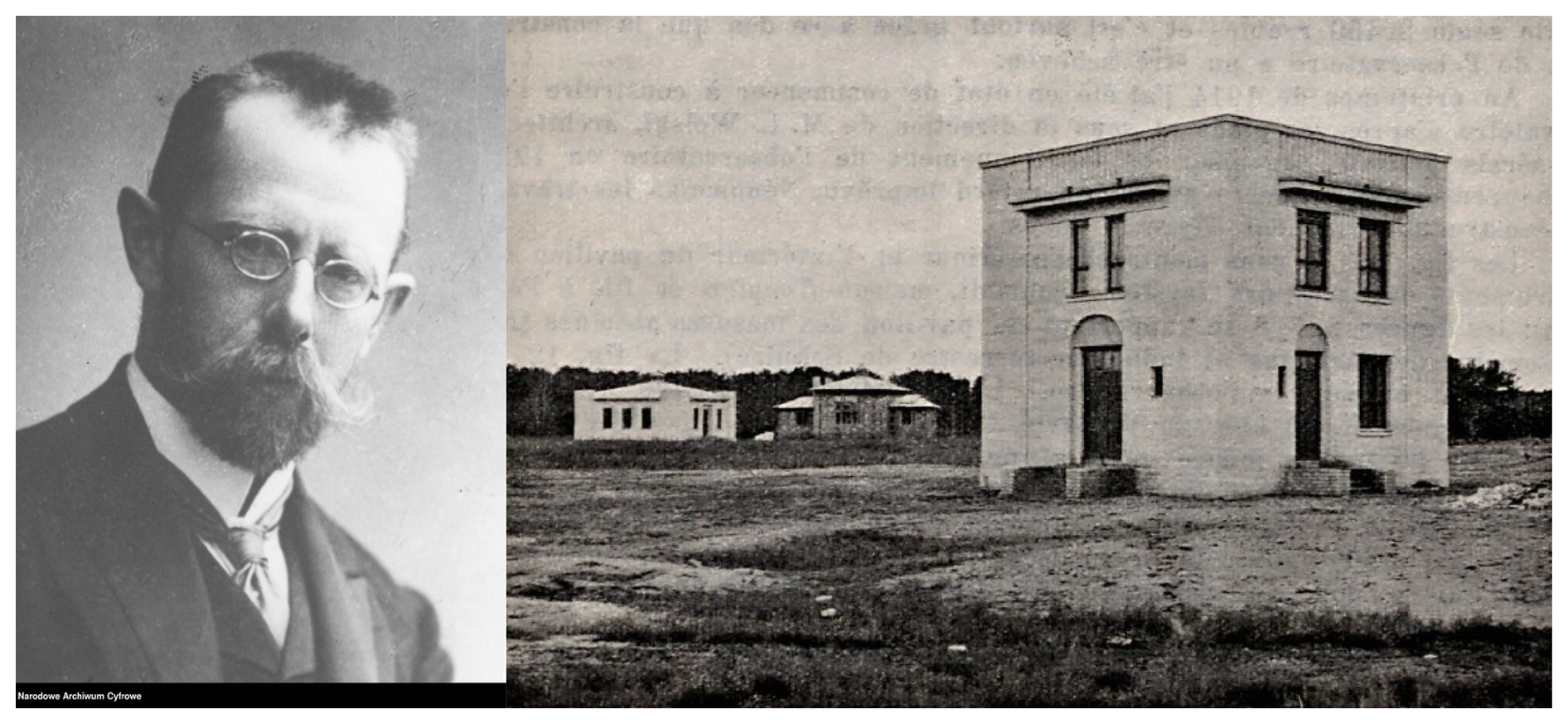
Figure 1Left: Portrait photo of Stanisław Kalinowski in 1932, obtained from NAC – National Digital Archive, Poland, reference symbol 3/1/0/10/251 (public domain). Right: Photo of the site of the Świder Observatory from the side of the observatory main office (Brzozowa Street), adapted from Kalinowski (1915), page 23 (publication in public domain).
Professor Kalinowski planned and executed this undertaking when Poland existed as a semi-autonomous state; Otwock town and the nearby Świder resort where he bought a plot for the observatory site, was located in the Congress Kingdom of Poland, and briefly, during World War I, the Regency Kingdom2. The observatory houses were built over years 1913–1915, some magnetic apparatus was purchased prior to it (Kalinowski, 1915). The instruments and buildings closely followed the examples of already active, internationally recognised magnetic observatories. Specifically, Kalinowski had visited Pavlovsk, and, with the architect he employed, Łukasz Wolski, they visited Potsdam and Seddin (Linthe, 2023a, b). As a result of Kalinowski's wish and his association with the Museum of Industry and Agriculture the Observatory was affiliated to the Physics Laboratory at the Museum, and its special commission supervised expenditures. It was also agreed that providing any future running and development costs were on the observatory. Fortunately, at this time the regained independence created opportunities to apply for funding to the state, so further development was possible, although still not without disappointments and setbacks. The beginning of continuous operation was delayed by World War I, which trapped Kalinowski on the other side of the front, after he had visited family in Kyiv. The Observatory was not damaged by the end of the war, and the site was finally ready for an opening in the independent Poland in 1920, but this time the matters were interrupted by the war with the Soviets, and the observatory was evacuated, so there was another official opening on 1 January 1921. A photograph of an early view of the observatory site (then the Magnetic Observatory in Świder), and a portrait photo of its founder, Stanisław Kalinowski, are shown in Fig. 1.
The history of the institution and its founder deserves more attention and research. Here, after a brief but necessary introduction we proceed to the times of the birth of atmospheric electricity observations at the Magnetic Observatory in Świder. There are relatively few studies on this period of the observatory work, hence an attempt to start correcting this shortfall, and to add to the Observatory efforts to save and promote its heritage. There are not too many original sources both on the history and the results of these observations. The magnetic work and publication of magnetic results seem to have been prioritised, and other various struggles delayed publication of electric results. The materials summarising first nine years of results in preparation for a publication perished in the early bombings of Warsaw by the Luftwaffe in September 1939. The Museum building was also damaged in 1939 and further burnt with the documentation in 1944 (Kalinowski, 1946). From the records of National Culture Fund (Fundusz Kultury Narodowej, FKN), the institution instrumental to the matter, very small part survived but some information remained in the published reports (FKN, 1931, 1937). A good source on the overall situation of the pre-war3 Observatory years are Archives of Kalinowski Family, at present safeguarded by the Polish Academy of Sciences Archives in Warsaw. It was catalogued in 2007–2008, and an inventory was published in 2011 (Chodkowska, 2011). There are just a few pre-war and post-war observatory publications, the Travaux de l'Observatoire Géophysique à Świder series, e.g., Kalinowski (1937c), and especially the “Jubilee Book” by Kalinowska (1962); in addition to a few reports and research papers that give some details or mentions. Last but not least the national reports to the International Association of the Terrestrial Magnetism and Electricity provide details reported by Kalinowski (1937d, 1939), very brief but substantial in this situation. Hopefully, other existing but undiscovered or forgotten sources will emerge in the future to create a fuller picture of the times and proceedings.
2.1 Motivation and successful beginning
There is no doubt in that the magnetic work was the primary aim and activity of Kalinowski and the Observatory in Świder. This is shown by the observatory's published results and international collaboration. Kalinowski made exchange visits and run correspondence with other researchers and magnetic observatories from all over the world (Kalinowska, 1962). In the 1937d national report to International Association for Terrestrial Magnetism and Electricity (IATME) he writes: “When the work of the Swider Observatory in the field of terrestrial magnetism was finally organized, and all that remained was to execute the established plan, an idea came to me to expand this work by embracing several other branches of Physics of the Earth, thus gradually transforming our Magnetic Observatory into a Geophysical Observatory.”4. A plan for an extension of routine observations at Świder by atmospheric electricity measurements emerged at that point at the latest. An important factor could be was that Kalinowski was aware that electrification of the railway may one day threaten the magnetic observations and thus the existence of the observatory – this is also why he had chosen Świder as for the area these plans were considered distant at the time5 (Kalinowski, 1915). A few other circumstances might have helped him to the idea of choosing atmospheric electricity. Firstly, from the start he was motivated by the actions of Carnegie Institution of Washington and its Department of Terrestrial Magnetism which ran and funded a lot of atmospheric electric observations (Brown, 2005). Bringing atmospheric electricity measurements into magnetic observatories and Carnegie Institution of Washington undertakings was initially encouraged by Julius Elster and Hans Geitel (Fricke and Schlegel, 2017). Indeed, some observatories used to carry out both magnetic and atmospheric electric work simultaneously, and, for example, between Świder and Kakioka (Japan) there was a regular exchange of published works as the observatory used to post their publications to other magnetic observatories. In general there was a growing worldwide scientific interest in this field at the beginning of the 20th century, including Poland. Already at the turn of the century professor August Witkowski mastered the atmospheric potential gradient (PG) measurement technique in Zakopane, using a radioactive collector method, and also measured the electrical conductivity of the air for a short period (Witkowski, 1902). Next, professor Władysław Smosarski measured air conductivity and the atmospheric potential gradient for several years (1923–1929) in Golęcin (Smosarski, 1953). By the 1920' geomagnetism and atmospheric electricity have become regular research topics of interest to Earth scientists world-wide, represented in, e.g., the International Union of Geodesy and Geophysics (founded in 1919), and its Section on Terrestrial Magnetism and Electricity (Ismail-Zadeh and Joselyn, 2019). For example, one of the resolutions at the General Assembly in Rome (1922), later reaffirmed in Madrid (1924), considered it desirable to have “in every country at least one observatory making systematic atmospheric-electric observations (especially of potential gradient, earth-air currents, conductivity, and number of ions) which are intercomparable amongst themselves and comparable with similar observations made in other countries”. Kalinowski was ambitious and rather consequent in his actions despite difficulties and progress becoming slow from time to time, and certainly took note (IUGG1924, 1924).
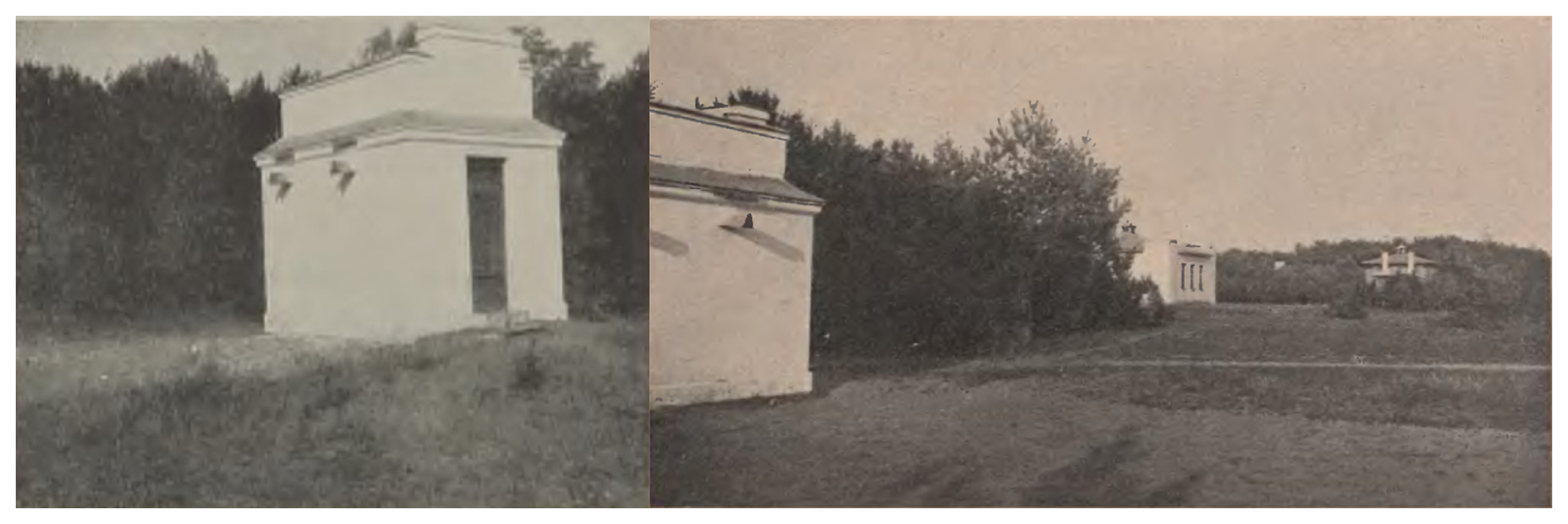
Figure 2House built for atmospheric electricity measurements at Świder. Left: Side view of the building as shown in Kalinowski (1932). Right: Side view with one magnetic building in the background, view from Zaciszna Street, reproduced from Szpecht (1939), page 205. The open area next to the building is visible, as well as holes in the building for pulling wires through, on such wire is sketched in Fig. 5). A larger area for measurements in the open space spread further to the right – see also the photo in the left panel of Fig. 1.
A breakthrough which established the era of atmospheric electricity observations at Świder was receiving a grant from National Culture Fund which allowed purchasing any necessary specialised equipment (FKN, 1937). Years 1926–1930 are reported by Kalinowska (1962) as more financially stable and more prosperous which finally enabled these new investments. Prior to receiving the grant, construction of another observing house was arranged at the observatory site as the center for the new atmospheric electricity measurements (Fig. 2). This building was finished in 1925, and Mierzejewski (1925) in his guide on national scientific institutions announced the measurements would start that year. This was not to be until 1928 (Kalinowski, 1937d). Then the funds enabled purchase of four L. Castagna Benndorf electrometers (at first one, and another three at the end of the year), Wulf electrometer and two other electrometers, a ionisation chamber, an Ebert ion counter, and a Spindler&Hoyer Gerdien tube apparatus (Kalinowska, 1962; Warzecha, 1958). Specifically, the FKN subsidy of 30 000 zloty in June 1928 allowed to purchase the three Benndorf electrometers, radioactive collectors, isolators, and three calomel batteries (FKN, 1931). In addition, the pavilion was refurbished (damp was a problem) thanks to the financial assistance. Measurements of the atmospheric potential gradient with one electrometer were installed by Dr Henryk Jędrzejowski, a new employee in 1928. Over 1929–1931 the work on PG observations was continued by Mr Antoni Liliental after rather soon departure of experienced Dr Jędrzejowski, and eventually, after departure of Mr Liliental, taken over by the observatory staff. Continuous measurements of the atmospheric potential gradient using two radioactive collectors and two Benndorf electrometers started on 1 October 1929 (Kalinowski, 1932).
2.2 Development, pre-war crisis and war
In the observatory report of 1934–1935 Kalinowski (1937c) writes: “For several years our observatory's activities have gone beyond the strict field of terrestrial magnetism. Our electrical pavilion provided us with lavish material on the atmospheric potential gradient. We conduct a range of activities related to studies of the radioactivity of water and minerals. We have begun measurements of solar radiation. We intend to establish meteorological observations in conjunction with electrical observations. This will allow our Magnetic Observatory to transform into a Geophysical Observatory, and I consider it right to change our observatory's name and the title of its publications. The name “Geophysical Observatory” will better reflect the nature of our work and development trends. Furthermore, this change will be stimulating in our pursuit of the programme of a true Geophysical Observatory.”6
The Observatory was renamed but the years that followed were not as successful. In fact, the observatory was all the more troubled by financial problems and insufficient number of staff. There were also other issues concerning the results of the magnetic work which affected the future work, and Kalinowski personally7. Over many years professor's only permanent scientific staff at the observatory were the assistants Wanda Drège (since magnetic measurements over the Congress Kingdom in the 1910's), and, since 1921, his daughter Zofia Kalinowska8. The younger daughter Ewa Kalinowska-Widowska was a student at the time but worked voluntarily part-time and joined the scientific staff after the World War II. We give brief curriculum of the people working on early atmospheric measurements at Świder in Appendix A. Maintaining larger number of staff become an obstacle for realistion of the full scope of atmospheric electricity observations planned at Świder, and performing the initiated measurements might have not come without difficulties for Kalinowski and the faithful assistants. Antoni Liliental's work at the observatory started during his summer internship from Warsaw University of Technology in 1929 (Kalinowski, 1932; Kalinowska, 1962). After his departure there were no new employments in atmospheric electricity section of the observatory activities until the war outbreak in 1939, so the PG observations were looked after by Wanda Drège and Zofia Kalinowska, in addition to their magnetic observations commitments (Kalinowski, 1932). This might have changed in later years, with Ewa Kalinowska playing a distinct role, as Kalinowski in one of the letters explained that his daughter Ewa voluntarily led the atmospheric electricity section of the Observatory (Kalinowski, 1937a).
The planned measurements of air electrical conductivity and electricity of precipitation seem never to be conducted, at least on a regular basis. In the next report to IATME, shortly before the disaster of 1939, Kalinowski (1939) writes: “When I presented a report from our Observatory to the International Association of Terrestrial Magnetism and Electricity in Edinburgh in 1936, I hoped that the subsequent report to the Washington Session would give a considerably broadened and deepened picture of work, in keeping with the new name of the Observatory, “Geophysical” (not just “Magnetic”). Regretfully, these expectations proved illusory; they were based on the unrealised expectation of an increase in our resources.”. Further, on atmospheric electricity work: “Our limited resources prevented us from carrying out our program. We continued recording electrical potential using two Benndorf electrometers of varying sensitivities. We took absolute measurements at plain surface and made comparison measurements for the site terrain model to determine the value of the reduction coefficient. The installation for recording variations of atmospheric air conductivity and the electrical state of precipitation made no progress due to lack of resources. This same problem also suspended the studies initiated on actinometry, radioactivity, and meteorology.”.
During the war the Observatory lost the results of analysis of 1929–1938 years of PG measurements considered ready and for publication and in preparation of it. The materials were temporarily moved to Kalinowski's office at home in Warsaw, and the manuscripts, including some original recording notes, did not survive already the beginning of the war (Kalinowski, 1946). Most importantly, lost were the results of measurements that allowed calculating the PG reduction factor. At Warsaw University of Technology a plaster model of the terrain of the PG measurement site surroundings was destroyed that had served the reduction coefficient calculations with a different method. The observatory itself managed to remain relatively unscathed and maintain the magnetic work in dangerous circumstances but the PG observations were stopped as any purchases of the tracing paper required for the recording appeared impossible or too expensive (Kalinowski, 1946). Atmospheric electric work was resumed in 1948 in a completely different reality for Poland and the Observatory (Czyszek, 1954; Kalinowska-Widomska, 1955; Warzecha, 1958).
3.1 Measurement instalations
The first and only pre-war published paper on the atmospheric electric measurements at Świder gives first details about the experimental set-up and personnel involved (Kalinowski, 1932). For the measurements of the atmospheric potential gradient the observatory used L. Castagna Benndorf electrometers (Benndorf, 1906), and the aforementioned radioactive collectors covered with ionium (230Th), also purchased from Vienna. The Benndorf electrometer is a quadrant electrometer with registering accessories leaving trace on sheets of recording paper and creating charts of measured potential difference variation (an electrogram). The device was often used in atmospheric electricity observatories at the time both in the field work, and in observatories (Simpson, 1905; Angeheister, 1975; Harrison and Riddick, 2022; Fujii and Nagamachi, 2022; Nagamachi et al., 2022; Harrison and Riddick, 2024). In Fig. 3 we reproduce the photograph of the electrometer, and a modified diagram from the paper of Benndorf (1906). Another examples from Lerwick Observatory (UK) and Kakioka Observatory (Japan), with an explanatory diagram can be found in Harrison and Riddick (2022); Nagamachi et al. (2022).
A collector is an isolated conducting probe with a radioactive coating to speed up the process of acquiring the electric potential of surrounding air (e.g. Wåhlin, 1986), an equaliser (Nagamachi et al., 2022; Harrison and Riddick, 2022). As Kalinowska-Widomska (1955) mentions, initially the observatory had their collectors covered with polonium, which later was replaced with ionium collectors as ionium had longer radioactive decay times. This may be the situation shortly after the Second World War II as initially, as Kalinowska (1962) reports, ionium collectors were purchased. Warzecha (1958), in the first post-war published yearbook, mentions of ionium collectors, too.
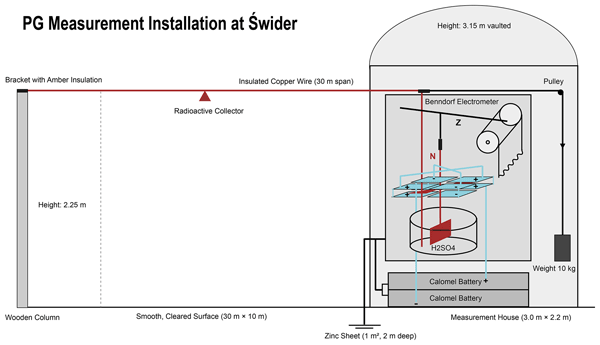
The electrometers were housed in the newly rebuilt hut (Figs. 2, 4). Kalinowski (1932) describes: The only window is opposite the door; both the window and the door are double. The single-room building is 3.0 m long, 2.2 m wide and (in the middle) 3.15 m high (the ceiling is vaulted). In the left wall (towards the door) you can see two holes, which are 180 cm apart. Two horizontally stretched copper wires are led into the house through these holes, one end of each of which is attached by means of a bracket with amber insulation to a strong wooden column located 30 m from the house; the other end of each cable is connected by means of a similar bracket to a wire which passes over a pulley and is tensioned with a sufficient weight. In the middle of both insulated wires the radioactive potential probe is located, metallically connected to the wire 2.25 m above the ground. The ground beneath the wires is smooth and completely cleared of grass on a rectangular surface measuring 30 m x 10 m.9. Inside the house (see also Fig. 5): “two Benndorf mechanically recording electrometers are set on metal brackets on the inside of the wall. One of these electrometers is set to a lower sensitivity, the other to a higher sensitivity. The end of one of the above-mentioned wires inside the pavilion is connected to the needle of one electrometer, the end of the second wire to the needle of the second electrometer. Calomel batteries are used to charge the quadrants; the quadrants of the less sensitive electrometer are charged to ± 50 V, those of the more sensitive to ± 100 V. ...The earthing is made by means of a zinc sheet with a surface area of about 1 squared meter, which was buried 2 m deep in the moist ground.”. A diagram for the measurement installation based on the above descriptions is shown in Fig. 5.
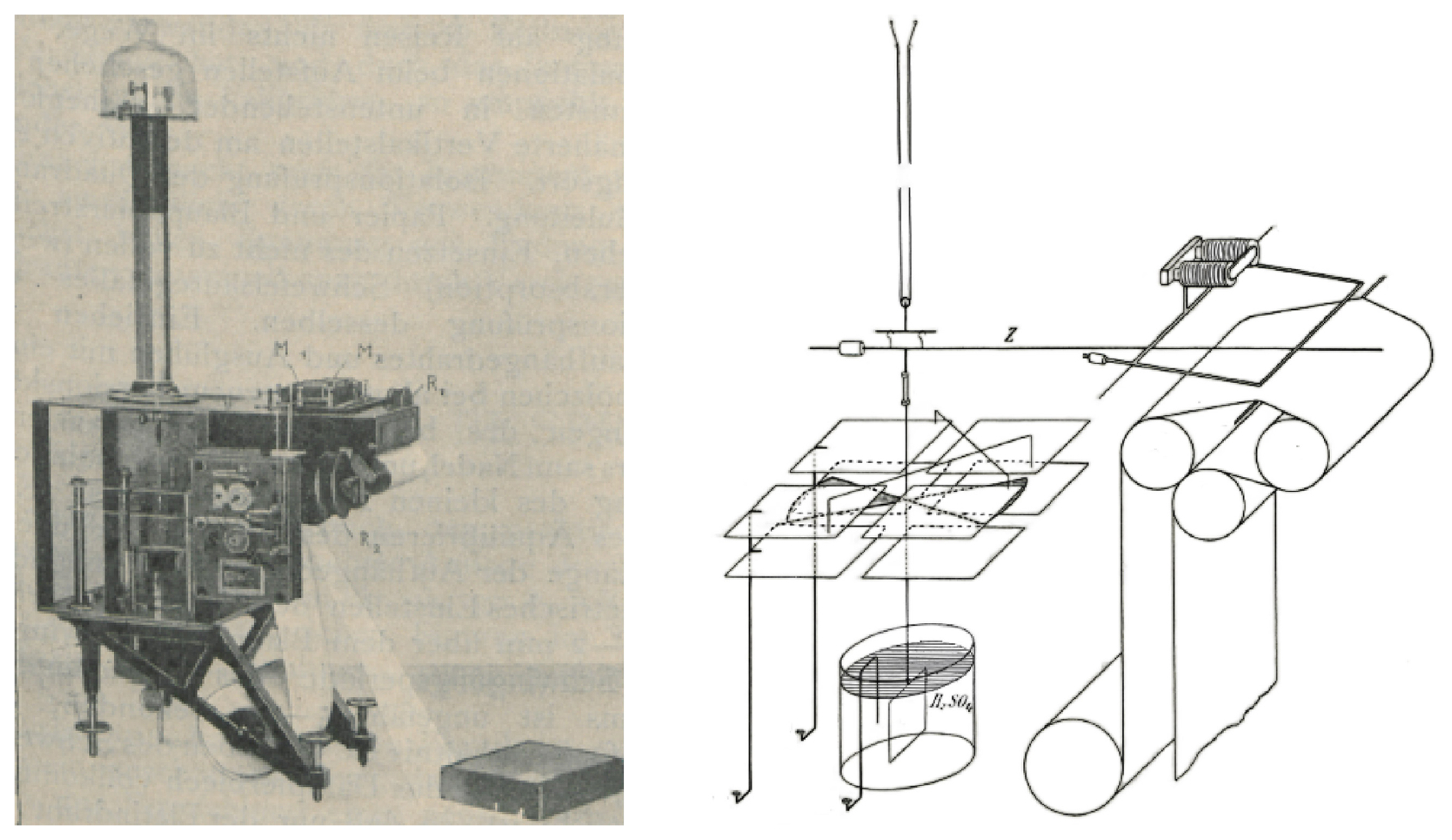
Figure 3A photograph (left) and a diagram (right) of the Benndorf recording electrometer adapted from Benndorf (1906). The main part of the electrometer is the vertical “needle” connected with the quadrant plate placed between plate electrodes, and via sulfuric acid solution, a connection wire that acquires the electric potential to be measured. From the top it is connected to, but electrically isolated from, a horizontal pen-connecting rod, Z, itself connected with a pen-pressure adjuster controlled by an electromagnet. The pen positions itself according to the value of the external voltage and touches the paper sheet moving between rollers as controlled by the clock mechanism. In the original diagram, the clock mechanism have been omitted for clarity.
There are more details given by Kalinowska-Widomska (1955), who then used installation almost identical to the pre-war operation10: the weight tensioning the wires was 10 kg weight, and this ensured that the distance between the conductors and the ground (reported as 2.30 m) remained constant independent of air temperature. The spacing between collectors was 2 m, also: “The sensitivity of the electrometers was checked once every two weeks; the auxiliary battery was monitored using a Weston voltmeter. The zero line was marked at the beginning and end of each electrogram, that is, for each day; the condition of the insulation was also checked twice a day.” 11. The collector system were not without some limitations and drawbacks, especially sensitive part was ensuring the right isolation of the collectors, and maintaining the electric potential on the measuring device.
Despite rigorous maintenance of the installation, there was another concern about the determination of the reduction factor as the observatory site was surrounded by trees, and in such a situation the surroundings affected the potentials measured. A usual practice in atmospheric electricity research is to give the PG value as if it was measured above a flat plane, so reduction factors have to be calculated for any specific site. Kalinowski (1932) mentions that low trees grew at a distance of about 10–15 m from the collectors, and there was a larger number higher trees farther from the site. Measurements have therefore been also taken at plain terrain in greater distance from the site but the results were considered unreliable. In this situation another method was proposed which involved creating a model of terrain and calculate distorsion to the potential.
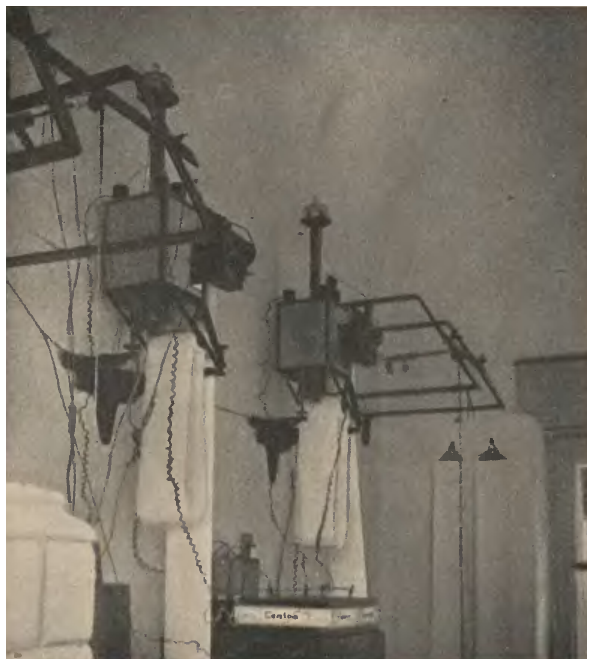
Figure 4Inside of the atmospheric electricity measurement house with a view on two installed Benndorf electrometers hanged on the wall with brackets. The casing of each electrometer is earthed, and its plate electrodes are connected to a battery standing on the floor. The electrometers' needles are connected to wires coming from the outside, themselves connected to radioactive probes. Photograph from Szpecht (1939), page 214 (public domain).
Ewa Kalinowska as an experimental physics student was probably involved with the pre-war measurements of the reduction factor (Chodkowska, 2011), and was familar with the problem. More details are given by Kalinowska-Widomska (1955) on the operation completed post-war: The determination of the reduction coefficient at Swider, under natural ground conditions, was carried out using two collectors, one placed above the other at a distance of one meter. For this measurement, we used a Wulff two-wire electrometer, and observations were taken over several hours at two-minute intervals. Comparing the values recorded by the Benndorf electrometer with the average values calculated from long series of direct observations taken simultaneously above the flat surface allowed us to determine the reduction coefficient relative to the surface. By repeating this measurement several times, we were able to eliminate random errors in the average value. The results of these measurements obtained before the war differed from the value obtained on the model by about 10 %.
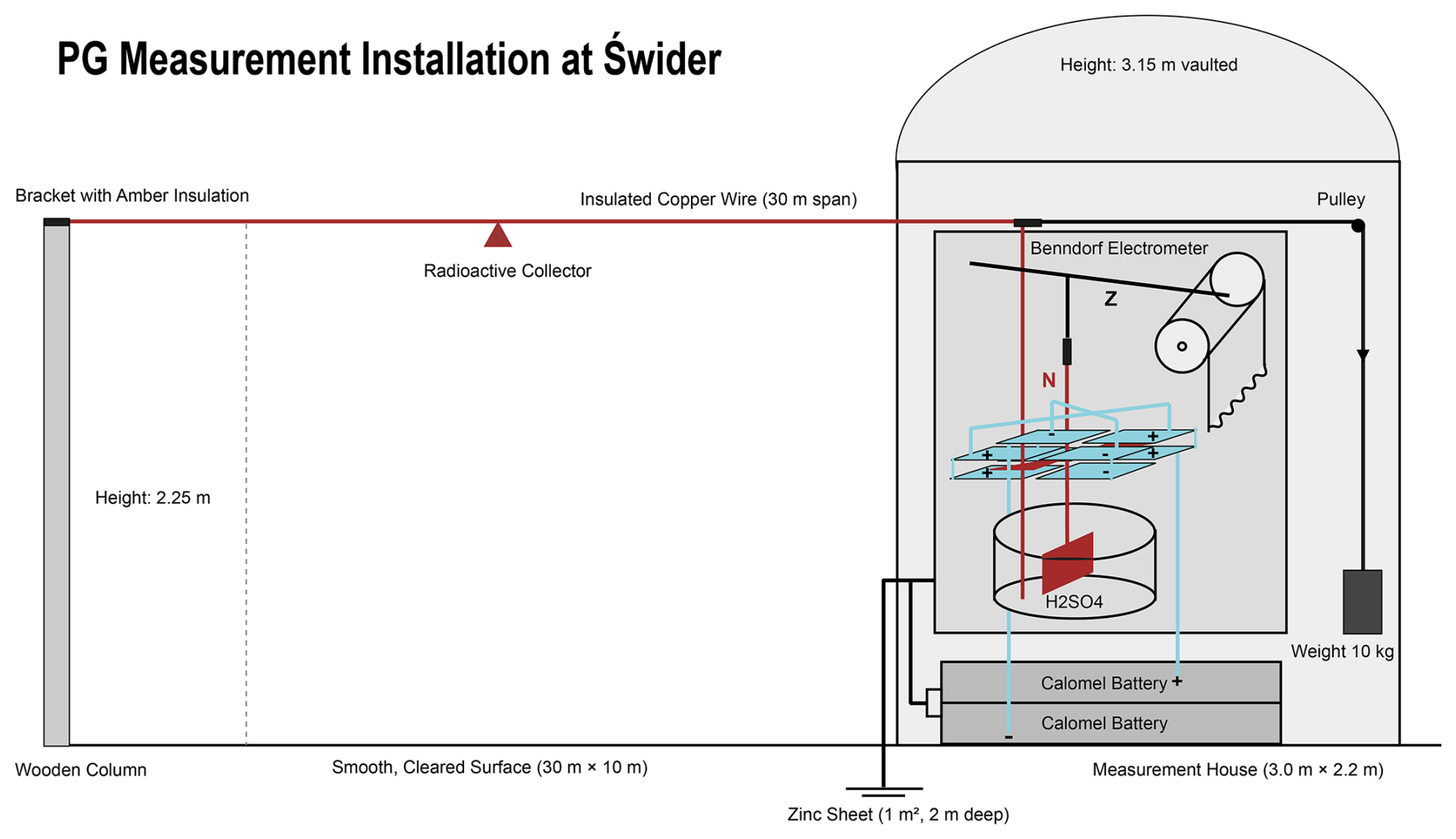
Figure 5A diagram of the measurements installation of the atmospheric electric potential at Świder 1929–1939, with sizes of the house and clearing over which a wire with a radioactive collector was stretched (Fig. 2) and connected to a Benndorf electrometer (Fig. 3) inside the house (Fig. 4). For clarity only one wire, and one electrometer was drawn (N denotes the electrometer's needle, and Z its pen rod). In addition, the recording part is indicated only by the roller with the recording paper. More description is in the text.
3.2 Early results
Because of the problems with the reduction factor Kalinowski in Kalinowski (1932) refrained from giving the absolute values of the potential and its changes. He described the diurnal variation qualitatively as of the same type as in most stations in the northern hemisphere: “a double daily wave in the summer, and a single one in the winter”. After the war Kalinowska-Widomska (1955) confirmed this conclusion with the pre-war measured PG given for 1930 year only, using new measurements and calculations of the reduction factor (Fig. 6).
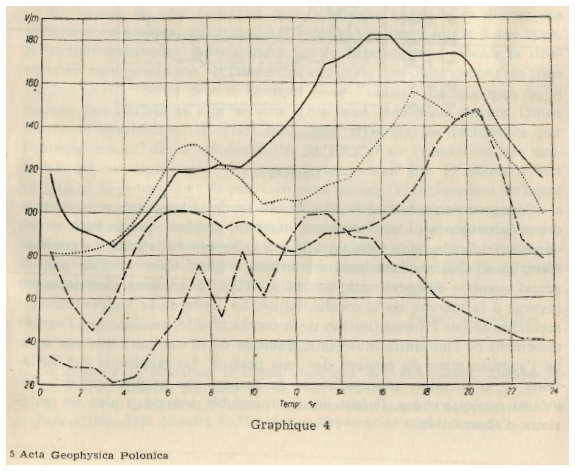
Figure 6Plots of the diurnal variation in GMT of the atmospheric potential gradient on undisturbed days in 1930 as analysed by Kalinowska-Widomska (1955), Fig. 4 in her work. Solid line – Winter, dotted line – Spring, dashed line – Summer, dot-dashed line – Autumn. Plot reproduced from Acta Geophysica Polonica, vol. 3, at the Library of Institute of Geophysics Polish Academy of Sciences.
From Table 3 of hourly mean averages in Kalinowska-Widomska (1955) it can be calculated that the day mean average PG value for undisturbed days in 1930 is 101 V m−1. Seasonal averages are 136, 116, 94 V m−1 for Winter, Spring, and Summer, respectively, and only 58 V m−1 for Autumn. The measurements error is estimated at 10 V m−1, or 12 %. Kalinowska-Widomska concludes that the low values in Autumn 1930 might be due to problems with insufficient insulation in the measuring system.
After World War II the Geophysical Observatory in Świder became primarily an atmospheric electricity station with a wide scope of measurements on atmospheric electricity, meteorology, air pollution and air radioactivity (Warzecha, 1958). In 1946 it has been renamed Stanisław Kalinowski Geophysical Observatory. These first years of atmospheric electric and meteorological measurements of 1928–1939 undoubtedly have influence on the Observatory's post-war future, especially taking into account that magnetic observations were moved in 1976 to a newly built observatory in Belsk. The observatory was joined by new staff whose scientific interests were in atmospheric science and meteorology, and the observatory's work and equipment drifted in this direction, a change that was fully supported by the new management (Kalinowska, 1962; Warzecha, 1983). Importantly, the basis was provided as there was already the scientific experience and instruments. Another chapter has begun. Year 2024 marked 95 years from the beginning of regular recordings and research that began, after 10 years of progress hold up and set back but eventually restored and developed over next decades (Note, 1947; Warzecha, 1968; Dziembowska, 2009).
One L. Castagna Benndorf electrometer and the Spindler&Hoyer Gerdien tube still exist in the Observatory but are no loger used. One Benndorf electrometer was replaced in April 1964, and the second in September 1967; the Gerdien apparatus was used till the end of 1964. The Observatory stores old instruments, some of which are exhibited in a small museum initiated by Zofia Kalinowska (Warzecha, 1984). In 2024 they were on display at the Earth Museum of Polish Academy of Sciences (PAS) at a temporary exhibition (Muzeum Ziemi, 2024) co-organised with the Institute of Geophysics PAS which is the current owner of the Observatory. The atmospheric electricity building also still exists at the observatory, and in 2024 was registered in the national heritage listing (Portal Otwocki, 2024)12.
Świder Observatory staff working with 1928–1939 atmospheric electricity measurements13:
-
Stanisław Kalinowski (1873–1946). Benedykt Stanisław Kalinowski (he used only his middle name, Stanisław) was born in 1873 in Lebedyn, Ukraine, to Franciszek and Aleksandra née Głowacka. He graduated in Physics from Kyiv University and became an assistant to Professor G. de Metz in the Department of Physics. In Kyiv where he had to stay for the second time during World War I he was also involved in political and social activity (Mścisławski, 2024). In 1899 he moved with newlywed wife Maria Olecka to Warsaw. He declined the offered position of assistant at Warsaw University of Technology as he did not want to work at a government university in the Congress Kingdom. Instead, he began teaching in private secondary schools, founding teachers' organisations, launching new journals, and even organising private universities. He also took a job as a curator of the collections at the Museum of Industry and Agriculture. In 1902 he started PhD studies at W. K. Roentgen Laboratory in Munich. After return to Warsaw he resumed the teaching career. In the Physics Laboratory that he recreated at the Museum he conducted demonstrations for private schools without their own laboratories until 1914 (Olszaniec, 2024). At this time his big project of creating of a magnetic observatory under auspices of the Museum came to life. Before it happened he began making field measurements. In 1921 he was appointed associate professor at the Faculty of Chemistry of the Warsaw University of Technology, and the Magnetic Observatory started to work continuously. At the 4th Congress of the International Geodetic and Geophysical Union in Stockholm he presented the first magnetic map of Poland. He was the author of over 40 monographs on terrestrial magnetism, teaching, physics textbooks. Associated with the Polish People's Party (PSL) “Wyzwolenie” (Liberation), he served as a senator of the Republic of Poland from 1922 to 1927 and chairman of the Senate Education Committee, and, from 1928 to 1930 as a member of the Sejm (lower house of Polish parliament) and chairman of the Sejm Education Committee (Gałyga, 2024). He was one of the organisers and president of the Polish Physical Society, a member of the Polish Chemical Society, the Warsaw Society of Geophysicists, the International Geodetic and Geophysical Union, the International Meteorological Organization, the Royal Astronomical Society. He had three daughters, two of whom (Zofia and Ewa) worked with him at the Observatory and the Physical Institute. He died in 1946 and was buried in the cemetery in Otwock (Chodkowska, 2011). Kalinowski's activity and his personality was commemorated by Hurwic (1956).
Stanisław Kalinowski decided that atmospheric electricity with meteorological measurements will be made at the Observatory in Świder. He made it happen in 1928, and this work was continued by his successors.
-
Wanda Drège (1887–1965). Wanda Drège was born in Koło in 1887 to Jan Drège and Helena née Farndell. Her father was a chemist, and he encouraged education of their daughters. In 1907, in line with her interests and considering the opportunities available at the time, Wanda Drège joined the Faculty of Mathematics and Natural Sciences of the Society for Scientific Courses (TKN). In the spring of 1909 she became an assistant of Professor Kalinowski at the Physics Laboratory at the Museum of Industry and Agriculture. In addition to assisting with lectures and instruments her special task was to assist with magnetic measurements undertaken by Kalinowski during field work. This job was to belong to her until 1949. The ultimate aim of these measurements was to create a magnetic map of the then Congress Kingdom of Poland. The measurements began in 1907 and were taken usually over summers, and in the winter Wanda was mainly occupied with teaching and testing measuring instruments. A departure for continuation of studies was planned in the autumn of 1911 but she decided to stay with the parents after the tragic death of her brother in the Tatra mountains. During the construction of the Observatory the field work was suspended, and this time Wanda assisted on site testing all materials for being non-magnetic. Maintaining the magnetic recording system in Świder after its launch required a dedicated employee who would be constantly on site operating the self-recording device, and supervising all apparatus. Wanda Drège, the first and only collaborator at that time, had assisted Professor Kalinowski in setting up and commissioning the variometer, permanently moved to Świder, and devoted her time and energy entirely to the Observatory. In 1922, the Observatory's staff was expanded by two people, allowing work on the magnetic mapping of Poland to resume in 1923 after a ten-year hiatus. This work, significantly expanded beyond its original intentions, was completed in 1929. During these eight years, of the total of 375 network points, 200 were obtained by Wanda Drège. Time between field trips was filled with station work and measurement processing. Throughout the interwar period and until 1944 she remained at the Observatory. After completing the mapping work, Wanda Drège undertook an individual project on Świsłocz magnetic anomaly but it was not completed by 1939. An accident in 1954 forced her to stop working with magnetism (Kalinowska, 1958). She died in 1965. Wanda was a member of Polish Physical Society.
Although Wanda Drège's work and interest mainly concerned magnetism, her constant availability and systematic station work was important for the survival of the observatory and upcoming atmospheric electricity era. As reported by Kalinowski (1932) she was involved in atmospheric electric work with Zofia which resulted in altogether 9 years of continuous PG measurements.
-
Zofia Kalinowska (1904–1983). Zofia Kalinowska was born in 1904 in Munich. She was a daughter of Stanisław Kalinowski and Maria née Olecka. She spent World War I with her family in Kyiv. From 1922 to 1927 she was a student at the Faculty of Mathematics and Natural Sciences of the Free Polish University, which at the time was not yet authorised to award a master's degree, and she obtained it only later. She began her work in the Magnetic Observatory in 1922 as a junior and later was appointed a senior assistant. She collaborated closely with her father Stanisław Kalinowski. She compiled results and prepared reports of the Observatory's work for the 4th Congress of the International Geodetic and Geophysical Union in 1930. She spent the occupation years at the Geophysical Observatory in Świder, working from 1940 as an assistant professor, and from 1946 to 1951 as the Observatory's director. This position was entrusted to her by the chairman of the Committee of the Museum of Industry and Agriculture. The Observatory remained within the Museum's structure until its liquidation, and in 1951 was incorporated into the organisational structure of the Polish Geological Institute in Warsaw, with Zofia Kalinowska remaining as the director. On 1 June 1953, following the liquidation of the Polish Geological Institute, the Observatory was incorporated into the newly established Department of Geophysics of the Polish Academy of Sciences. Zofia Kalinowska remained as the head and, from 1954, as acting head. That same year, she was awarded an academic title of associate professor, and in 1965 the title of docent. She authored over 30 articles on magnetism and numerous popular science articles. She was a member of the Union of Independent Socialist Youth, the Polish Teachers' Union, the Free Polish University Society, the Geophysical Society. She was involved in international collaboration working in the Secular Change Station Committee of the International Association of Terrestrial Magnetism and Electricity (Chodkowska, 2011). She retired in 1974, and died in 1983. During over 50 years of work at the Observatory she focused primarily on magnetic research, with particular emphasis on magnetic maps and studying secular variations. She was also involved in atmospheric electricity measurements from ca. 1931 at the latest.
As the successor at the management positions of the Observatory, Zofia Kalinowska gave her support for atmospheric electricity observations continuation at the Observatory after World War II (Warzecha, 1984).
-
Henryk Jędrzejowski (1897–1937). Henryk Jędrzejowski was a physicist and political activist. He was born in London in 1897 to Bolesław Antoni Jędrzejowski, a socialist party founder, and Anna Franciszka née Radecke. The family returned to Kraków, Poland, in 1905. Jędrzejowski was associated with Zakopane through his early school years and love of mountaineering in the Tatras. He also met his future wife there14. During World War I, he fought in the First Brigade of the Polish Legions and served in the First Uhlan Regiment. He studied at the Wawelberg and Rotwand State School of Mechanical Engineering and Electrical Engineering in Warsaw where in senior student years he also worked with professor Stanisław Landau-Ziemecki as an assistant in the Physics and Chemistry laboratories. Since youth he became close to PPS-Lewica (Left), a faction of Polish Socialist Party which later co-created Polish Communist Party, KPP (Kalabiński, 1987). From 1923 Jędrzejowski was employed at the Kernbaum Radiological Laboratory of Warsaw Scientific Society (Hurwic, 1986), and worked elsewhere as a lecturer. That year he married Jadwiga Prauss. The couple left for Paris where he continued studies and work at the Radium Institute, while his wife completed her own studies at the Sorbonne and graduated in geology. Appreciated as a young scientist by professor Ludwik Wertenstein and Maria Skłodowska-Curie, Henryk obtained two scholarships. After earning his doctoral degree in physics in 1927 he and his wife returned to Warsaw. He became a member of Polish Physical Society, and was considered the future head of the Physics and Chemistry Department of the planned Radium Institute in Warsaw. However, since he was a member of the Polish Communist Party he could not apply for a university or other responsible state position, and had to accept an appointment considered less ambitious such as a research assistant. In 1928 he was employed in the Geophysical Observatory at Świder. As he intensified his political activity for the Communist Party, his scientific career faded. In subsequent years he worked as a teacher in a vocational school. Repressions against the party activists increased in 1930' as a result of the anti-state character of the party. In 1932 he was charged with serving in one of the party's main department, and was imprisoned. After his release on bail he eventually left for the Soviet Union next year. He changed his name and was employed at an experimental facility. He was murdered during one of Stalin's “purges” ca. 1937. His wife Jadwiga Jędrzejowska received an official notification of her husband's death only in 1958 (Szemińska, 1979).
The political involvement transformed Henryk Jędrzejowski's life and, most probably, decided his fate, but his scientific experience must have been very useful for the ongoing work at the observatory in Świder with planned atmospheric electricity measurements. During his short spell at the observatory in 1928 he set up the first measurements of the atmospheric potential gradient with a radioactive collector method using a Benndorf self-registering electrometer.
-
Antoni Liliental (1908–1940). Antoni Tadeusz Liliental was born in Warsaw in 1908 to Natan and Regina Liliental née Eiger. His mother was an agile teacher and ethnographer (Hoffman, 2004; Liliental, 2023). Antoni Liliental studied Chemistry at Warsaw University of Technology, and in senior student years worked as a research assistant in the Department of Metallurgy and Metal Science directed at the time by professor Henryk Czochralski (Jakubiak, 2020). After graduating he worked scientifically at the Department at the Faculty of Chemistry. Perhaps looking for another career Antoni underwent military training. He completed the reserve officer cadet course with the 15th Infantry Regiment. Due to upcoming war his scientific and professional career was definitely ended in the summer of 1939. As a reserve officer he was called into the army in late August. His mobilisation assignment was 4th Tank and Armoured Car Battalion stationed in Brześć (Brest). He shared the fate of many soldiers, civil servants and other citizens finding themselves in the area soon occupied by the Soviets. He was captured, imprisoned in Kozielsk, and murdered in Katyń in April 1940. His name can be found on Katyń List No 2 (IPN, 2020).
Antoni Liliental completed summer internships at the Geophysical Observatory in Świder in years 1929–1930. He was employed as research assistant at the Physics Laboratory of the Museum of Industry and Agriculture but due to financial situation neither the Observatory or the Museum could guarantee his salary, and he left the job in November 1931 (Kalinowski, 1937b). At his observatory job, as Kalinowski (1932) and Kalinowska (1962) report, he continued the work of Henryk Jędrzejowski of atmospheric potential gradient measurements and set up a new pair of radioactive collectors with Benndorf electrometers. These measurements ran continuously until 1939.
-
Ewa Kalinowska-Widomska (1906–1976). Ewa Kalinowska was born in Warsaw in 1906 and was daughter of Stanisław and Maria Kalinowska née Olecka. She studied at the Faculty of Mathematics and Natural Sciences at the University of Warsaw, and graduated in Physics under supervision of Professor Stefan Pieńkowski. Since youth she was also involved in political activity. According to Krzemiński (1979) her professional activities can be divided into three main areas: teaching, work at the Physical Institute (formerly Physics Laboratory) of the Museum of Industry and Agriculture, and work at the Świder Observatory. She wrote several physics textbooks for secondary school students. She was the last director of the Museum's Physical Institute, and worked there throughout World War II, preserving the property. After the war, as the director she managed and overlooked its rebuilding and expansion before it was transferred to the Ministry of Education. At Świder Observatory she began work in 1924 as a volunteer and continued until her death in 1976. She married Władysław Widomski. Her work at the Observatory focused primarily on terrestrial magnetism, geomagnetic storms, and also included research on atmospheric electricity and meteorology.
Stanisław Kalinowski admitted she had led the atmospheric electricity section of the Observatory before Second World War. It is quite likely that we owe Ewa Kalinowska the tedious work on measuring and calculation of the reduction coefficient for Świder atmospheric potential gradient measurements.
No data sets were used in this article.
The author has declared that there are no competing interests.
Publisher's note: Copernicus Publications remains neutral with regard to jurisdictional claims made in the text, published maps, institutional affiliations, or any other geographical representation in this paper. The authors bear the ultimate responsibility for providing appropriate place names. Views expressed in the text are those of the authors and do not necessarily reflect the views of the publisher.
This article is part of the special issue “History of geophysical institutes and observatories”. It does not belong to a conference.
Author would like to thank Dr Anita Chodkowska of PAS Archives in Warsaw for selecting and preparing for viewing the requested materials from the Kalinowski Family Archives. Credits are also to Archives of Warsaw University of Technology and their helpful staff for the assistance and information about Antoni Liliental, particularly for confirming his involvement in the work at the Observatory, passed from family by Mr Marek Sołtyski. Author appreciates the response from Archiwum Akt Nowych in Warsaw in reply to an inquiry regarding survived records of National Culture Fund that followed a query at the National Archives – Archiwum Akt Nowych. Author also gratefully acknowledges Ms Aneta Beliniak for her assistance in adapting the diagram of the Benndorf electrometer to a digital version from Benndorf (1906).
This work was inspired by the work on digitisation of 1957–2005 yearbooks of Świder Geophysical Observatory during the funding project.
This research has been supported by the Narodowe Centrum Nauki (grant no. 2021/41/B/ST10/04448).
This paper was edited by Kristian Schlegel and reviewed by two anonymous referees.
Angeheister, G. G.: Geschichte des Samoa-Observatoriums von 1902 bis 1921, in: Zur Geschichte der Geophysik Festschrift zur 50 jährigen Wiederkehr der Gründung der Deutschen Geophysikalischen Gesellschaft, edited by: Birett, H., Helbig, K., Kertz, W., and Schmucker, U., Springer-Verlag, 43–66, https://doi.org/10.1007/978-3-642-65998-0_6, 1975. a
Benndorf, H.: Über ein mechanisch registrierendes Elektrometer für luftelektrische Messungen, Phys. Z., 7, 98–101, https://zdb-katalog.de/title.xhtml?idn=014205130&view=full (last access: 7 December 2025), 1906. a, b, c, d
Brown, L.: Centennial History of the Carnegie Institution of Washington, Volume II: The Department of Terrestrial Magnetism, Cambridge University Press, ISBN 9780521830799, 2005. a
Chodkowska, A.: Materiały Rodziny Kalinowskich, Biuletyn Archiwum PAN, 52, 72–125, 2011. a, b, c, d
Czyszek, W.: Der mittlere tägliche Gang des luftelektrischen Potentialgradienten an ungestörten Tagen in Świder, Acta Geophys. Polon., 2, 149–155, 1954. a
Dziembowska, A.: Eighty years of fair-weather atmospheric electricity monitoring in Poland, Publ. Inst. Geophys. Pol. Acad. Sci., 412, 9–14, 2009. a
FKN: Pierwsze sprawozdanie Funduszu Kultury Narodowej, 1/III 1928 – 1/IV 1931, Wydawnictwo Funduszu Kultury Narodowej, https://fbc.pionier.net.pl/id/oai:bc.wbp.lublin.pl:22135 (last access: 29 December 2025), 1931. a, b
FKN: Fundusz Kultury Narodowej (1928-1931) zarys działalności, Wydawnictwo Funduszu Kultury Narodowej, https://fbc.pionier.net.pl/details/nnrmlZT (last access: 27 June 2024), 1937. a, b
Fricke, R. G. A. and Schlegel, K.: Julius Elster and Hans Geitel – Dioscuri of physics and pioneer investigators in atmospheric electricity, Hist. Geo Space. Sci., 8, 1–7, https://doi.org/10.5194/hgss-8-1-2017, 2017. a
Fujii, I. and Nagamachi, S.: History of Kakioka Magnetic Observatory, Hist. Geo Space. Sci., 13, 147–170, https://doi.org/10.5194/hgss-13-147-2022, 2022. a
Gałyga, Z.: Działalność parlamentarna Stanisława Kalinowskiego, Prz. Geof., 69, 69–73, https://doi.org/10.32045/PG-2024-048, 2024. a
Harrison, R. G. and Riddick, J. C.: Atmospheric electricity observations at Lerwick Geophysical Observatory, Hist. Geo Space. Sci., 13, 133–146, https://doi.org/10.5194/hgss-13-133-2022, 2022. a, b, c
Harrison, R. G. and Riddick, J. C.: Atmospheric electricity observations at Eskdalemuir Geophysical Observatory, Hist. Geo Space. Sci., 15, 5–16, https://doi.org/10.5194/hgss-15-5-2024, 2024. a
Hoffman, H.: Dzieje polskich badań religioznawczych 1873–1939, Wydawnictwo Uniwersytetu Jagiellońskiego, ISBN 9788323317708, 2004. a
Hurwic, J.: Stanisław Kalinowski. W 10 rocznicę śmierci, Postępy Fizyki, 7, 255–264, 1956. a
Hurwic, J.: Pracownia Radiologiczna im. Mirosława Kernbauma przy Towarzystwie Naukowym Warszawskim. W 40. rocznicę śmierci Ludwika Wertensteina. Mirosław Kernbaum Radiological Laboratory of the Warsaw Scientific Society – on the 40th Anniversary of the Death of Ludwik Wertenstein, Postępy Fizyki, 37, 151–168, ISSN 0032-5430, 1986. a
IPN: Institute of National Remembrance, Katyń 1940, Katyn Lists, information based on records of Central Military Archive – Centralne Biuro Wojskowe CAW AP 3168 MiD WIH, and Katyń list L.W. 032/4 14 IV 1940 AM 1774, https://katyn.ipn.gov.pl/kat/form/r301860519171,LILIENTAL.html (last access: 16 September 2025), 2020. a
Ismail-Zadeh, A. and Joselyn, J. A.: IUGG: beginning, establishment, and early development (1919–1939), Hist. Geo Space. Sci., 10, 25–44, https://doi.org/10.5194/hgss-10-25-2019, 2019. a
IUGG: Resolutions passed at Madrid Meeting, 7 October 1924, International Geodetic and Geophysical Union, Section on Terrestrial Magnetism and Electricity, PAN Archiwum w Warszawie, Fonds III-228, Records of Kalinowski Family, file 22, 50, 1924. a
Jakubiak, M.: Jan Czochralski – pionier światowej elektroniki i inżynierii materiałowej, Dzieje Najnowsze, 52, 5–23, eISSN 2451-1323, 2020. a
Jóźwiak, W., Jankowski, J., and Ernst, T.: Natural Variations of the Geomagnetic Field: Observations and Application to Study of the Earth's Interior and Ionosphere, Springer International Publishing, 65–84, ISBN 978-3-319-07599-0, https://doi.org/10.1007/978-3-319-07599-0_4, 2014. a
Kalabiński, S.: Henryk Jędrzejowski, Książka i Wiedza, Warszawa, Słownik biograficzny działaczy polskiego ruchu robotniczego, vol. 2, p. 277, ISBN 8305116573, 1987. a
Kalinowska, Z.: Życie i praca Wandy Drège. Referat Zofii Kalinowskiej wygłoszony na uroczystości jubileuszowej 50-lecia pracy adj. W. Drège w dniu 13 czerwca 1958r. (Life and work of Wanda Drège. Zofia Kalinowska speech at the 50 years of work jubilee of adiunkt W. Drège, on June 13, 1958), PAN Archiwum w Warszawie, Fonds III-228, Records of Kalinowski Family, file 61, 39–45, 1958. a
Kalinowska, Z.: Historia powstania i działalności Obserwatorium Geofizycznego w Świdrze w latach 1910–1960, Prace Obs. Geof. Świder (Travaux de l'Observatoire Géophysique de St. Kalinowski à Świder), 23, 9–36, Księga Jubileuszowa 1910–1960, 1962. a, b, c, d, e, f, g, h, i
Kalinowska-Widomska, E.: La marche des variations du gradient électrique de l'atmosphere a Świder sure les résultats de l'enregistrement mené en 1930 et 1950–1952, Acta Geophys. Polon., 3, 49–66, 1955. a, b, c, d, e, f, g
Kalinowski, S.: Obserwatorium Magnetyczne w Świdrze pod Warszawą, Dzieje pierwszego na ziemiach polskich obserwatorjum magnetycznego, offprint from journal “Wektor”, online at Polona collection of Biblioteka Narodowa (National Library, Poland), https://polona.pl/preview/90f2c8f0-4d94-4249-9700-018e591c5283 (last access: 17 September 2025), 1915. a, b, c
Kalinowski, S.: Do Ministerstwa W.R. i O.P., PAN Archiwum w Warszawie, Fonds III-228, Records of Kalinowski Family, file 19, 38–41, 1927. a
Kalinowski, S.: Über die Registrierung des zeitlichen Ganges des luftelektrischen Potentials in Świder, Acta Phys. Polon., 1, 499–502, 1932. a, b, c, d, e, f, g, h, i, j
Kalinowski, S.: PAN Archiwum w Warszawie, Fonds III-228, Records of Kalinowski Family, file 41, 180–189, 1937a. a
Kalinowski, S.: Do pp. Członków Polskiego Towarzystwa Fizycznego (To the members of Polish Physics Society), PAN Archiwum w Warszawie, Fonds III-228, Records of Kalinowski Family, file 41, 107–108, 1937b. a, b
Kalinowski, S.: Wyniki spostrzeżeń magnetycznych w Świdrze Résultats des observations magnétiques à Świder (Pologne) 1934–1935, Prace Obs. Geof. Świder (Travaux de l'Observatoire Géophysique de St. Kalinowski à Świder), 9, 3, https://polona.pl/preview/12ebd82c-934d-445f-a8df-ff14ff51e1ec (last access: 20 December 2025), 1937c. a, b
Kalinowski, S.: Poland. – Travaux de l'Observatoire Magnétique de Swider 1933–1936, in: IAGA, Transactions of Edinburgh Meeting, 17–24 September 1936, International Union of Geodesy and Geophysics, Association of Terrestrial Magnetism and Electricity, edited by: La Cour, D., Bartels, J., and Bruun de Neergaard, M., Horsholm, Copenhagen, IATME Bulletin No. 10, 129–130, https://doi.org/10.25577/9y2w-n249, 1937d. a, b, c
Kalinowski, S.: Poland – Travaux de l'Observatoire Magnétique de Swider, in: IAGA, Transactions of Washington Meeting, 4–15 September 1939, International Union of Geodesy and Geophysics, Association of Terrestrial Magnetism and Electricity, edited by: Goldie, A. H. R. and Joyce, J. W., Neill & Co. Ltd., Edinburgh, IATME Bulletin No. 11, 129–130, https://doi.org/10.25577/ykh7-dq52, 1939. a, b
Kalinowski, S.: O przebiegu pracy w okresie wojny światowej 1939–1945. Sur le cours du travail pendant la guerre mondiale 1939–1945, Prace Obs. Geof. Świder (Travaux de l'Observatoire Géophysique de St. Kalinowski à Świder), 10, 5–17, https://polona.pl/preview/f29f348f-6286-4d15-98d8-ef0c8476d592 (last access: 20 December 2025), 1946. a, b, c
Krzemiński, W. K. E.: Dr Ewa Kalinowska-Widomska (1906–1978), Acta Geophys. Polon., 27, 105–107, 1979. a
Liliental, W.: Wspomnienie. Matusia musiała samodzielnie mnie wychować. Dzięki niej pozostałem Polakiem, Gazeta Wyborcza, https://wyborcza.pl/7,162657,30361933,matusia-musiala-samodzielnie-mnie-wychowac-dzieki-niej-pozostalem.html (last access: 27 July 2024), 2023. a
Linthe, H.-J.: History of the Potsdam, Seddin and Niemegk geomagnetic observatories – Part 1: Potsdam, Hist. Geo Space. Sci., 14, 23–31, https://doi.org/10.5194/hgss-14-23-2023, 2023a. a
Linthe, H.-J.: History of the Potsdam, Seddin and Niemegk geomagnetic observatories – Part 2: Seddin, Hist. Geo Space. Sci., 14, 43–50, https://doi.org/10.5194/hgss-14-43-2023, 2023b. a
Mierzejewski, H.: Polskie placówki badawcze: nauki fizyczne, technika, Warszawa: Wydawnictwo Akademji Nauk Technicznych: Skład Główny w Administracji Przeglądu Technicznego, https://polona.pl/item-view/4105830a-9578-473b-82e3-e73c8d793503 (last access: 8 August 2024), 1925. a
Muzeum Ziemi: WYSTAWA CZASOWA: ”PIĘKNE I BESTIE”, https://mz.pan.pl/piekne-i-bestie/ (last access: 17 September 2025), 2024. a
Mścisławski, L.: Stanisław Kalinowski w Kijowie w latach 1915–1918, Prz. Geof., 69, 59–67, https://doi.org/10.32045/PG-2024-047, 2024. a
Nagamachi, S., Arita, S., and Hirota, E.: Historical data of atmospheric electric field observations in Japan, Geosci. Data J., 10, https://doi.org/10.1002/gdj3.143, 2022. a, b, c
Note, N.: Stanislaw Kalinowski and the Swider Geophysical Observatory, Nature, 160, 359, https://doi.org/10.1038/160359c0, 1947. a
Olszaniec, G.: Działalność edukacyjna i popularuzjąca naukę Stanisława Kalinowskiego w Muzeum Przemysłu i Rolnictwa, Prz. Geof., 69, 49–57, https://doi.org/10.32045/PG-2024-046, 2024. a
Portal Otwocki: Kolejne budynki Obserwatorium Geofizycznego w Otwocku uznane za zabytki, https://portalotwocki.pl/kolejne-budynki-obserwatorium-geofizycznego-w-otwocku-uznane-za-zabytki/ (last access: 17 September 2025), 2024. a
Simpson, G. C.: Atmospheric electricity in high latitudes, Proc. Roy. Soc. A, 76, https://doi.org/10.1098/rspa.1905.0014, 1905. a
Smosarski, W.: Electricité atmosphérique à Poznań, Acta Phys. Polon., 1, 33–43, 1953. a
Szemińska, A.: Jadwiga Jędrzejowska, Przegląd Lekarski– Oświęcim, 195–199, English translated by T. Bałuk-Ulewiczowa for Medical Review Auschwitz project, https://mra.piebm.org/library/jadwiga-jedrzejowska/ (last access: 16 September 2025), 1979. a
Szpecht, J.: Wśród fizyków polskich. Seria 1, Państwowe Wydawnictwo Książek Szkolnych, Lwów, online at Kujawsko-Pomorska Biblioteka Cyfrowa, https://kpbc.umk.pl/dlibra/publication/75254/edition/86027/content (last access: 20 December 2025), 1939. a, b
Warzecha, S.: Introduction. Rocznik elektryczności atmosferycznej i meteorologii, Annuaire météorologique et de l'électricité atmosphérique 1957, Prace Obserwatorium Geofizycznego im. St. Kalinowskiego w Świdrze, Travaux de l'Observatoire Géophysique de St. Kalinowski à Świder, 16, 5–10, 1958. a, b, c, d
Warzecha, S.: Introduction. Rocznik elektryczności atmosferycznej i meteorologii, Annuaire météorologique et de l'électricité atmosphérique 1965, Prace Obserwatorium Geofizycznego im. St. Kalinowskiego w Świdrze, Travaux de l'Observatoire Géophysique de St. Kalinowski à Świder, 38, 3–8, 1968. a
Warzecha, S.: Doc. Zofia Kalinowska 1904-1983 (notice nécrologique – obituary), Publ. Inst. Geophys. Pol. Acad. Sci., 168, 3–6, 1983. a
Warzecha, S.: Zofia Kalinowska (1904–1983), Acta Geophys. Polon., 32, 119–121, 1984. a, b
Witkowski, A.: Note sur l'electricite atmosphérique a Zakopane dans les Tatras, Bull. Acad. Sci. Cracovie A, 42, 7–10, 1902. a
Wåhlin, L.: Atmospheric Electrostatics, Research Studies Press, ISBN 0863800424, 1986. a
Full title of the charity: “Fund for Assistance for People Working in the Scientific Field, named after Dr. Józef Mianowski, MD”, Polish short name “Kasa Mianowskiego”.
Poland regained independence in 1918.
World War II.
Translation from French.
The possibility of the electrification started in the late 1920's but those plans have been abandoned. In the meantime Kalinowski negotiated with Polish railway company ways to compensate for the loss, and set up measurements at other locations (Kalinowski, 1927).
Translation from French.
In addition to some misunderstandings at the Physics Laboratory, it was discovered that the hourly values of magnetic Z component had been reported with an opposite sign, and the results for the affected period needed to be corrected. For that reason Kalinowski and his work was critisised (Kalinowski, 1937b; Kalinowska, 1962).
Zofia Kalinowska become the head of the Observatory after professor's death.
Translation from German.
Different voltages were applied to plate electrodes of the two electrometers, ± 200, and ± 600 V, respectively.
Translation from French.
The main office, magnetic buildings and the Kalinowski' villa were enlisted in 1979.
In order of employment date.
In early 20th century Zakopane was a popular place, attracting many social and political activists, artists, physicians, and scientists.