 | 22 Jun 2026
Obituary: Bodo Reinisch (1936–2025)


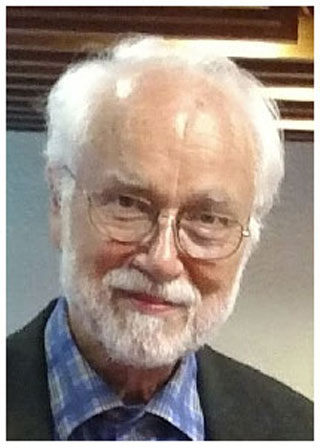
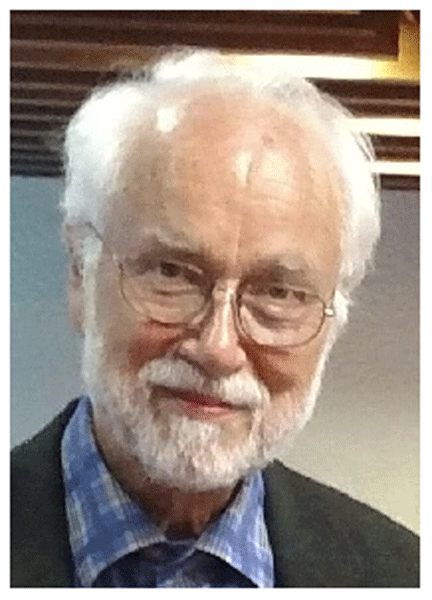
Bodo Walter Reinisch passed away on 16 December 2025. He was born on 26 November 1936, in Beuthen, Silesia, then part of Germany. The sudden war-related upheaval and the traumatic escape were life-shaping events of his early adolescence. He grew up in Hausach, a village in the Black Forest in Baden-Württemberg, where his family was resettled after the war and where he became a beloved star of the local soccer team. These early years were difficult, and he helped support his family with various jobs during high school and later during university summer breaks. Sports were always important in his life. He continued playing soccer throughout his university years, regularly returning home for weekend matches with his team, and he also competed and excelled in table tennis.
He studied physics at the Albert-Ludwigs-Universität Freiburg and was accepted as a graduate student by Karl Rawer, then director of the Ionosphären Institut Breisach. This was a formative and exciting time in his development as a scientist. Many of his fellow graduate students – including Rolf Kraft, Jürgen Büchau, and Gerhard Schmitdke – remained lifelong friends. He also had the opportunity to work alongside established scientists such as Ewald Harnischmacher, Klaus Bibl, Rudolf Eyfrig, Hannes Hesse, Adolf Paul, and Klaus Jacobs, who had already made significant contributions to ionospheric research. During these years, Bodo developed a lasting passion for ionospheric physics and for the techniques used to observe and study ionospheric plasma.
Science and sports were not his only pursuits. Bodo was also a member of the Freiburger Bachchor, a renowned choir that once included Hildegard Behrens, the famous soprano of later years. He proudly recalled singing in performances of Bach's Weihnachtsoratorium and Matthäus Passion, and he especially treasured the occasion when as part of the choir he shared the stage with the famous baritone Dietrich Fischer-Dieskau.
The year 1963 marked an important milestone: he completed his Diploma in Physics and later that year became Ionospheric Station Chief at the Breisach Institute. In the same year, he married Gerda, whom he had met and fallen in love with during a study semester in Munich and who became his lifelong partner. His main research interests during these demanding early years included D- and E-region absorption, sporadic-E layer observations, and whistler data analysis.
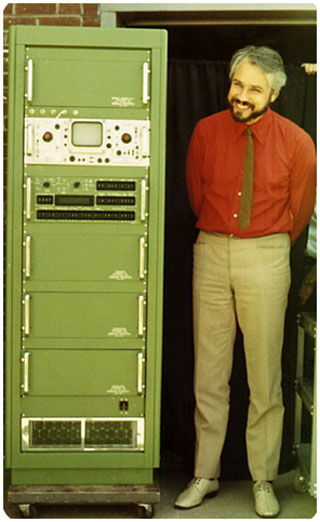
In 1965, Bodo and Gerda emigrated to the United States and settled in Bedford, Massachusetts, attracted by the presence of several organizations engaged in ionospheric research. Bodo's friend Jürgen Büchau had emigrate with his family a few years earlier and convinced him that this was the right career move, which indeed it proved to be. Unlike Büchau, who worked at the Air Force Geophysics Laboratory in Bedford, Bodo chose the university path and joined the University of Massachusetts Lowell (UML) as a research physicist, pursuing his Ph.D. alongside funded research. This marked the beginning of a 45-year career at UML. He became Professor and later Chair of the Electrical Engineering Department, and in 1975 founded the Center for Atmospheric Research (now the Space Science Laboratory), serving as its director until his retirement in 2010. During his time at UML, Prof. Reinisch made outstanding contributions to ionospheric and plasmaspheric research in three primary areas: the development of the Digisonde, the development of the Radio Plasma Imager (RPI), and major contributions to the International Reference Ionosphere (IRI).
He was the driving force behind the development of the Digisonde, an advanced automated ionosonde that revolutionized space weather research by enabling continuous monitoring of Earth's ionosphere. Today, more than 70 Digisondes operate worldwide. They provide far more comprehensive information than earlier ionosondes, and their unique autoscaling capability makes ionospheric data rapidly accessible for space weather forecasting and global assimilative models. This achievement was made possible by Bodo's experimental insight, technical innovation, and leadership at UML's Center for Atmospheric Research. Together with his colleague Xueqin Huang, Bodo published a series of seminal papers in the 1980s describing mathematical algorithms for converting ionogram traces into electron density profiles. These papers have become classics and remain foundational for anyone using radio sounding to probe ionospheric plasma. Applying these techniques to topside sounder ionograms made it possible to analyse the vast data sets collected by the Alouette and ISIS satellites during the 1960s through 1980s. This work led to renewed efforts in topside modeling and to significantly improved models of electron density in the topside ionosphere. Prof. Reinisch's involvement was essential to the successful completion of this effort.
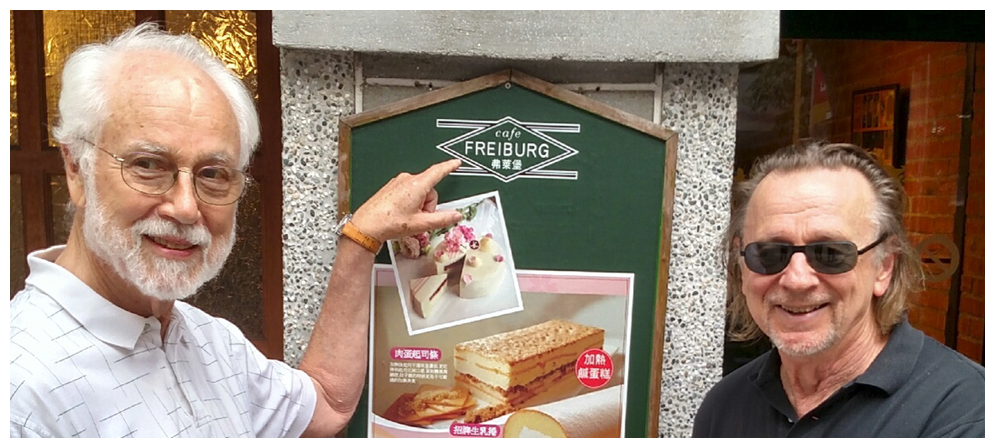
Figure 3Bodo and the author excited about finding Café Freiburg in Taoyuan City, Taiwan during the 2017 IRI Workshop there; Freiburg is the site of their alma mater Albert-Ludwigs University where both received most of their university education.
He revolutionized not only ionospheric probing from the ground but also plasmaspheric probing from space. His Radio Plasma Imager (RPI), flown on the Imager for Magnetopause-to-Auroral Global Exploration (IMAGE) satellite, was the first plasmaspheric sounder and provided unprecedented imaging of plasmaspheric densities along magnetic field lines. Bodo and his team demonstrated that field-aligned density distributions cannot be described as constant or as simple diffusive equilibrium profiles, as assumed in many earlier models. RPI measurements offered unique insights into inner magnetospheric structures and dynamics and stimulated a new generation of plasmasphere and polar cap models, including those developed by Prof. Reinisch and his group. No other data source provides such detailed information about electron density in the plasmasphere. Overcoming numerous technical and programmatic challenges, he led the successful design and implementation of this unique instrument. The success of the RPI mission stands as a testament to his scientific and technical vision.
Prof. Reinisch also made significant contributions to the development of the International Reference Ionosphere (IRI), a joint project of International Union of Radio Science (URSI) and the Committee on Space Research (COSPAR) and the standard model of Earth's ionosphere as recognized by the International Standardization Organization (ISO). His improvements to the IRI electron density profile in the bottomside and E-region, based on data from the expanding global Digisonde network, were essential for radio wave propagation studies and practical applications of the model. In recognition of his leadership, he was elected to become Chair of the IRI Working Group and served from 2002 to 2010. A regular participant in the biannual IRI workshops (Fig. 3), he made significant contributions that helped ensure the success and vitality of these gatherings. He also was the editor for many of the IRI-dedicated issues of Advances in Space Research.
After retiring from UML in 2010, Bodo founded Lowell Digisonde International (LDI), a company that continued to build and further develop Digisondes and distribute them worldwide. Throughout his career at UML and LDI, he mentored many students and early-career scientists, offering guidance not only in their scientific work but also in their professional and personal lives.
Prof. Reinisch is remembered internationally for his seminal contributions to radio science and plasma physics. In recognition of his achievements, he received the Appleton Prize of the International Union of Radio Science (URSI) in 2011, with the citation: “For revolutionizing radio sounding from ground and space with development of the Digisonde and the IMAGE/RPI satellite instrument, both essential data providers for space weather monitoring and ionospheric modeling.” In 2014, he was awarded the Kristian Birkeland Medal for Space Weather and Space Climate. He was an active member of URSI, serving as Vice Chair and then Chair of Commission G, and helped found the first ionospheric COST Action in Europe and actively participated in the follow-on Actions. He served the scientific community also in his role as Associate Editor of Radio Science (1987–1997) and IEEE Transactions on Antennas and Propagation (2003–present).
Shaped by his childhood experiences during and immediately after World War II, Bodo rejected war and violence and strongly advocated international collaboration and mutual understanding as pathways to a more peaceful world. His commitment to international cooperation benefited science and engineering in both developing and developed nations. German-American relations were particularly important to him. He was deeply engaged in the greater Boston community and played a central role in founding the German International School Boston, which has grown steadily and has become a recognized success. In acknowledgment of these efforts and his scientific achievements, he was awarded the Officer's Cross of Merit First Class (Bundesverdienstkreuz 1. Klasse) by the President of Germany.
Dr. Reinisch made transformative contributions to the field of radio remote sensing of space plasmas and to the development of related models. His passing represents a profound loss to the ionospheric and radio science communities. We have lost not only an exceptional scientist, but also a generous mentor, an inspiration, and a dear friend.